Photo: Fixedsun (CC0)
Job description
Traders build and backtest algorithmic strategies against historical data, write the code that executes trades automatically, and watch live performance throughout the trading day, ready to adjust models or pull back risk exposure as conditions shift. The role also involves analyzing market microstructure data to sharpen execution and enforcing strict position limits in real time. During market hours the pace is intense, with real losses riding on split-second decisions, which is part of why pay is often heavily bonus-driven and tied directly to strategy profitability. It's a job that blends serious math and programming skill with the ability to stay composed under constant pressure.
Pros
- Exceptional upside earning potential up to $500k, among the highest-paying quantitative careers
- Strong pay even at the entry level for those with the right quantitative background
- Intellectually intense work combining coding, statistics, and real-time decision-making
Cons
- Long, demanding hours of 50 to 65 per week are standard in the role
- Extremely fast-paced, high-pressure environment where split-second decisions carry real financial losses
- Bonus-heavy compensation ties pay directly to strategy performance, adding real income volatility
A typical day
Screens on by 6:45am: the trader reviews overnight P&L, checks that every automated strategy behaved as designed, and reads the risk report before markets open. The open itself is the day's most alive stretch — models trade automatically, but the trader watches fills, spreads, and anything anomalous, ready to cut a strategy's size if the market's behavior drifts from the assumptions underneath it. Mid-morning a data feed hiccups and one strategy gets flattened in seconds; better flat than wrong. The afternoon splits between improving execution logic with the researchers and a post-close review of the day's trades against the model's expectations. Discipline, not adrenaline, is what compounds.
Tasks at the job
- Design and backtest algorithmic trading strategies against historical market data.
- Monitor live trading systems and market conditions throughout the trading day.
- Adjust models and parameters in response to changing market behavior.
- Manage risk exposure and enforce position limits in real time.
- Write and optimize code that executes trades with minimal latency.
- Analyze market microstructure data to refine execution strategies.
Workplace & working conditions
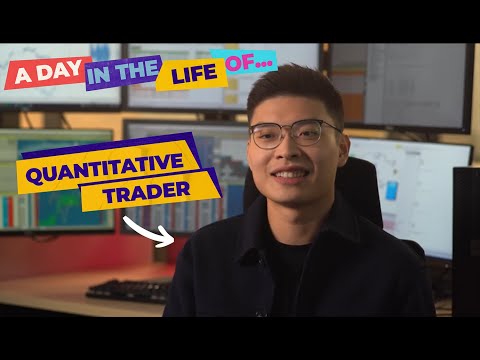
Work happens indoors at a trading desk facing multiple monitors of live market data.
The pace during market hours is extremely fast, with real money and real losses riding on split-second decisions. The role demands intense focus and significant independent judgment under constant time pressure.
Education necessary or common
Bachelor's or advanced degree in math, statistics, computer science, physics, or a related quantitative field
Common college majors
Licenses & certifications
- FINRA licenses as required by role (employer-sponsored)
Career path
Related fields
Courses to take
- AP Calculus BC — the mathematical foundation
- AP Statistics — probability under uncertainty is the entire game
- AP Computer Science A — strategies live in code
- AP Economics — market structure and incentives
- AP Physics — modeling dynamic systems
Clubs, activities & competitions
- Math competitions: AMC/AIME
- USACO or programming club
- Poker or strategy game clubs — expected-value thinking with real stakes
- Investment club with a paper portfolio
First steps you can take now
- Learn expected value cold: analyze a simple game of chance completely
- Paper-trade a rule-based strategy for 60 days and log every deviation you were tempted to make
- Learn Python and pull free market data with a library like yfinance
- Read one market-microstructure explainer to learn how orders actually execute