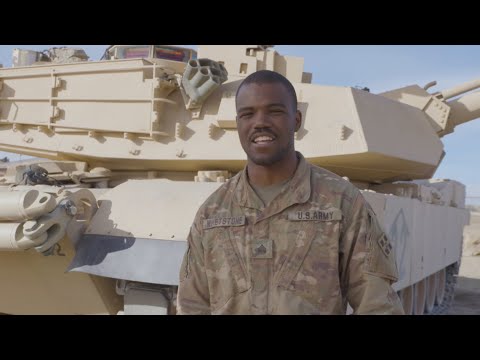
Photo: The National Guard (CC BY 2.0)
Job description
Beyond driving the vehicle itself, crew members are responsible for operating and maintaining its targeting, firing, and communications systems, plus routine maintenance and inspections to keep it combat-ready. During field exercises and deployments, crews often work, eat, and sleep in or around their vehicle for extended stretches, in whatever climate they're stationed in. The job requires tight coordination since each crew member's role directly affects whether the others can do theirs safely, and decisions during live operations often have to be made in seconds with real consequences. It's a physically confined, high-stakes role built around teamwork under pressure.
Pros
- Operates and maintains advanced armored vehicle systems, building specialized technical skills
- Close-knit crew structure where teamwork and trust directly determine mission success
- Hands-on mechanical and tactical training with clear real-world application
Cons
- Confined working space inside the vehicle for extended stretches during operations
- Real physical risk during live combat operations with fast, high-consequence decisions
- Above-average hours and extended field time, often sleeping outdoors or inside the vehicle
A typical day
Motor pool by 6:30: before a tank moves anywhere, the crew runs preventive maintenance checks — track tension, fluid levels, optics, radios — because a 70-ton vehicle forgives nothing neglected. A field training day means mounting up in assigned positions: driver in the hull reading terrain through periscopes, loader slamming rounds into the breech in under five seconds, gunner tracking targets through thermal sights while the vehicle bucks. Gunnery tables are scored and crews live by their qualification ratings. Back at garrison, the afternoon is cleaning weapons, more maintenance, and drills rehearsed until crew coordination is wordless. The tank is home, workplace, and shared responsibility.
Tasks at the job
- Drive tanks, light armor, or amphibious assault vehicles in training and combat operations.
- Operate and maintain targeting, firing, and onboard weapons systems.
- Operate communications and navigation equipment while moving as part of a unit.
- Perform routine maintenance and inspections on the vehicle and its systems.
- Transport personnel and equipment safely through combat or field environments.
- Operate auxiliary weapons such as machine guns or grenade launchers as needed.
Workplace & working conditions
Work happens in and around armored vehicles in the field, in all climates and weather, with crew members often working, eating, and sleeping outdoors or inside the vehicle during training and deployment.
The job involves confined working space inside the vehicle, real physical risk during live operations, and close teamwork since each crew member's role depends on the others performing theirs correctly. Decisions in combat situations have to be made quickly, with significant consequences for the crew and mission.
Education necessary or common
—
Licenses & certifications
- ASVAB qualification and armor crewman training (earned in service)
Career path
Courses to take
- Shop / Auto Mechanics — crews are their vehicle's first mechanics
- Physical Science / Physics
- Algebra
- PE / weight training — the job is physical in confined spaces
Clubs, activities & competitions
- JROTC
- Team sports — small-unit coordination is the daily skill
- Any mechanical hobby: engines, mowers, cars
- Scouting — fieldcraft and camping competence transfer
First steps you can take now
- Talk to Army and Marine recruiters about armor crewman roles (19K and 1812 respectively) and ask what the training pipeline looks like
- Take ASVAB practice tests — mechanical and spatial sections matter for this field
- Get comfortable with vehicle maintenance basics on any car available to you
- Start a fitness program built around the Army Combat Fitness Test events