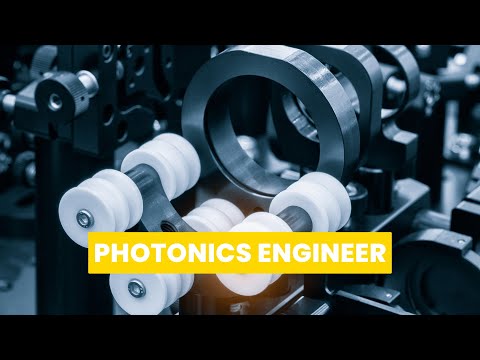
Photo: European Space Agency (CC BY-SA 3.0 igo)
Job description
The work runs from early design through production: modeling how a proposed optical or imaging system should perform, then building and testing prototypes such as laser or fiber-optic components. Photonics engineers often specialize in one application area, imaging systems, signal processing, or fiber optics, and because the underlying technology moves fast, staying current means regular reading and professional development. Most of the work is collaborative, coordinating closely with other engineers and production staff to make sure a design that works on the bench also holds up at scale.
Pros
- High upside earning potential, up to $190k
- Bachelor's degree is enough to enter a specialized, technically advanced engineering field
- Over 9,300 positions nationwide across laser, fiber optics, and imaging applications
Cons
- Above-average hours, expect more than a standard 40-hour work week
- Slower job growth than many other engineering specialties, at 2.1% projected over the next decade
- Precision and accuracy are essential, since optical systems have tight tolerances for error
A typical day
The optical bench owns the morning: a new lidar transmitter design under test, and the engineer aligns the beam path mirror by mirror — micrometer adjustments while watching the power meter, because in photonics a misalignment measured in microns is the difference between a product and a paperweight. The data says the collimation drifts with temperature; the fix becomes the day's design problem, worked through thermal modeling and a mount redesign sketched into CAD before lunch. The afternoon shifts to the manufacturing side of the title: a yield meeting with the production team about fiber-coupling losses on the assembly line, where the engineer's redesigned alignment fixture is cutting failures measurably. A supplier call about laser-diode specs, an optics order, and a design review for a colleague's imaging module fill the rest. The last hour is quiet analysis — beam-profile data reduced and plotted. Light is the product; making it behave in mass production is the career.
Tasks at the job
- Analyze system performance or operational requirements.
- Develop optical or imaging systems, such as optical imaging products, optical components, image processes, signal process technologies, or optical systems.
- Develop or test photonic prototypes or models.
- Design, integrate, or test photonics systems or components.
- Assist in the transition of photonic prototypes to production.
- Read current literature, talk with colleagues, continue education, or participate in professional organizations or conferences to keep abreast of developments in the field.
Workplace & working conditions
Work happens indoors in a climate-controlled setting.
You're expected to exercise significant independent judgment day to day. Precision and accuracy are essential to the work. Almost all of the work is done as part of a team.
Education necessary or common
Bachelor's degree
Common college majors
Career path
Related fields
Courses to take
- AP Physics C — optics and electromagnetism are the discipline itself
- AP Calculus BC — wave math and engineering foundations
- AP Chemistry — materials, coatings, and semiconductors
- AP Computer Science A — instrument control and data analysis
- Electronics CTE courses — hands-on circuits and lab skills
Clubs, activities & competitions
- Science Olympiad — Optics is a recurring event
- FIRST Robotics — sensors and engineering practice
- Science fair with an optics project — spectroscopy and laser experiments are accessible
- Math team
First steps you can take now
- Build a spectroscope from a DVD and cardboard this weekend — real diffraction physics for five dollars
- Do the classic laser experiments safely with a cheap pointer: diffraction, interference, polarization
- Read how fiber optics carries the internet until total internal reflection makes sense
- Look up which universities have photonics/optical engineering programs — fewer than you'd think, well-placed graduates all