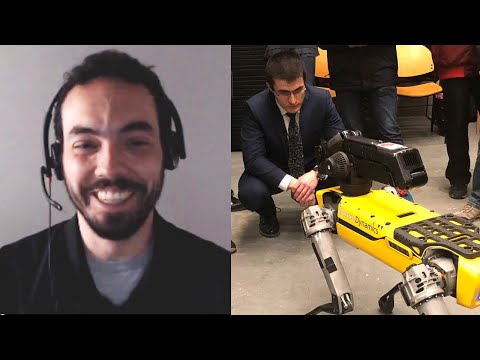
Photo: Jasonprost (CC BY-SA 4.0)
Job description
A roboticist designs a robot's physical structure and prototypes its mechanisms and sensors, then writes and tests the software controlling how it moves, perceives its environment, and makes decisions. Work involves running both simulations and physical trials to see how a design holds up under different conditions, and when something fails, mechanically or in code, tracking down the cause and refining the design. The job spans industrial automation, medical devices, self-driving vehicles, and research robotics, and typically means splitting time between a computer for software work and a lab or shop floor for hands-on building and testing.
Pros
- High earning potential up to $180k, strong even at the entry level
- Blends hands-on mechanical building with software and control systems design
- Applies across varied industries: automation, medical devices, self-driving vehicles, research
Cons
- Above-average hours, especially during intense pushes before demos or deadlines
- Debugging malfunctioning hardware demands patient, often frustrating, methodical troubleshooting
- Requires ongoing collaboration across mechanical, electrical, and software disciplines to succeed
A typical day
The lab morning starts where last night's test ended: the manipulation arm keeps dropping objects with unusual geometry, and the roboticist digs into whether the failure is perception (the vision model misjudging grasp points) or control (the gripper's force curve). A whiteboard session with the team maps the hypothesis; then it's code — adjusting the grasp planner, re-running the benchmark suite, and watching the robot try again, because in robotics the real world grades every idea. The afternoon holds a paper-reading group on a new learning approach, a design review for the next hardware revision, and a demo prep for a sponsor visit where the robot must behave. Progress is measured in failure modes eliminated.
Tasks at the job
- Design and prototype robotic mechanisms, sensors, and control systems.
- Write and test software controlling robot movement, perception, and decision-making.
- Run simulations and physical trials to evaluate robot performance under different conditions.
- Troubleshoot mechanical or software failures during testing and refine designs accordingly.
- Collaborate with mechanical, electrical, and software engineers to integrate subsystems into a working robot.
Workplace & working conditions
Work splits between a computer for software and simulation work and a lab or shop floor for building and testing physical prototypes, which can involve power tools, soldering, and moving machinery.
The work is iterative and self-directed for long stretches, punctuated by intense pushes before demos or deadlines. Debugging a malfunctioning robot demands patience and precise, methodical troubleshooting.
Education necessary or common
Bachelor's degree in robotics, mechanical engineering, or computer science; a master's or PhD is common in research-focused roles
Common college majors
Career path
Related fields
Courses to take
- AP Calculus BC — kinematics and control need it
- AP Physics C — mechanics is half of every robot
- AP Computer Science A — robots are software with consequences
- AP Statistics — perception and learning are probabilistic
- Shop or Engineering electives — building skills matter
Clubs, activities & competitions
- FIRST Robotics Competition — the definitive pipeline; colleges and companies recruit from it
- VEX Robotics
- Science Olympiad — robot events
- Maker club or personal builds documented online
First steps you can take now
- Join FIRST or VEX this season — or start a team if none exists
- Build and program something that moves this month: Arduino kit, wheeled robot
- Learn Python, then ROS basics through free tutorials
- Follow one research lab (MIT CSAIL, CMU RI) and watch their demo videos critically