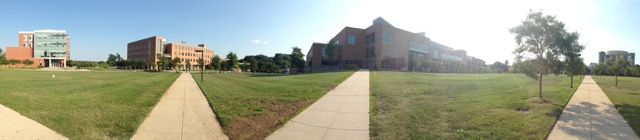
Photo: Scott218 (CC BY-SA 4.0)
School data & stats
Outcomes
Cost
Community
Overview
UMBC is a public research university known nationally less for its size than for what it has proven can be done with underrepresented students in STEM. Located in Catonsville, between Baltimore and Washington, D.C., and close to BWI airport, it has become a reference point for how a mid-sized public university can rival elite institutions in specific outcomes, an identity built around research access and mentorship rather than big-campus spectacle. Its brief but genuine moment of mainstream sports fame, a men's basketball upset of a top overall seed in the NCAA tournament, only reinforced a broader campus personality: unglamorous, hardworking, and quietly excellent.
Academics
Computer science, biological sciences, and engineering are the clear strengths, reinforced by close ties to the Baltimore-Washington research corridor and its national labs, federal agencies, and biotech employers. The Meyerhoff Scholars Program, which prepares students, originally underrepresented students in STEM specifically, for competitive PhD programs, is the university's most influential feature and has shaped a broader campus culture of undergraduate research even outside the program itself. Cybersecurity is another area of real strength given the region's concentration of federal and defense employers. Undergraduate research is treated as a normal part of an education here, not an add-on reserved for a select few, and the university's annual research showcase reflects how central that culture is.
Campus & student life
UMBC's culture is research-driven and intellectually earnest rather than traditionally social, and it has an unusually strong reputation for inclusivity in STEM. Its nationally competitive chess team, which recruits top players internationally and has won national collegiate titles, is a genuine point of campus pride and reflects a culture that rewards intellectual intensity over conventional campus glamour. The Retriever mascot and a modest but real athletics program round out student life, and the campus's location just outside Baltimore gives students access to the city without living inside it.
Getting in
Admissions rewards academic seriousness and STEM potential specifically, and applicants interested in the Meyerhoff Scholars Program or similar research tracks go through an additional, more competitive selection process on top of general admission. The Honors College offers another selective path for students who want smaller classes and closer faculty contact. UMBC tends to attract students who are drawn to its research reputation specifically rather than applying as part of a broader flagship search.
After graduation
UMBC has an outsized record of sending graduates, especially underrepresented students, into STEM PhD programs and research careers, with alumni concentrated in academia, biotech, and federal research institutions across the Baltimore-Washington corridor. Meyerhoff alumni in particular are cited nationally as evidence of what mentorship-driven STEM programs can do at scale. Employers and graduate programs in the region know UMBC's reputation well, even when it isn't the first name that comes to mind nationally.
Worth knowing
Students drawn purely by name recognition sometimes underestimate UMBC before arriving; its reputation is earned school-by-school and program-by-program rather than through broad brand recognition. Its research-first culture suits self-motivated students well but can feel less socially lively than a traditional flagship to students expecting a bigger, more conventional college social scene.
Admissions
Deadlines (2026–27 cycle)
Applying
umbc.edu ↗High school coursework
Required4 years of English · 4 years of mathematics (Algebra I, Geometry, Algebra II, plus an eligible math course senior year)
RecommendedA strong college-preparatory program including science, social science, and foreign language
Your fit, with your own numbers
With a free Dorado account, this tab fills in from your own profile and course plan:
- A chance band (Far Reach to Likely) calibrated against real admitted-student data — published test-score ranges and, where a school reports them, Common Data Set GPA profiles — with plain-English reasons.
- A fit breakdown across testing, grades, course rigor, activities, and honors, side by side with the numbers the school publishes.
- Deadline countdowns where verified application dates are on file.
Creating an account is free and takes no card — college search, list tracking, and fit are all included.
Create your free account