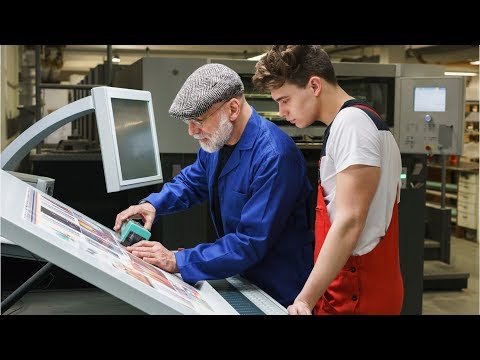
Photo: Tom T (CC BY 2.0)
Job description
Before a run starts, operators study job orders to confirm quantities, paper stock, and color specifications, then load the press and adjust feed and tension controls for that particular paper size. Test proofs get checked for ink coverage, density, and registration, and operators pull random samples throughout the run to catch problems early rather than after thousands of copies are printed. The pace is fast and deadline-driven, so operators need both good judgment and a steady eye for small inconsistencies.
Pros
- Larger job pool than many print-trade roles (13,700 positions) despite industry decline
- Hands-on mechanical work adjusting and troubleshooting presses rather than routine desk work
- Entry via HS diploma and on-the-job training, no college degree required
Cons
- Employment projected to shrink 8.1% over the next decade as digital printing displaces traditional runs
- Pay tops out around $63,520, capping long-term earning potential
- On-feet, fast-paced work with regular exposure to hazardous equipment and contaminants
A typical day
Makeready is the morning's craft: mounting plates for a four-color job, loading paper, setting ink keys, and pulling proof sheets until the color bars measure right and registration is dead-on under the loupe. Once the run starts, the operator's job becomes vigilance — pulling press sheets every few hundred impressions to check color drift, watching for web breaks or feeder jams, adjusting fountain solution on the fly. A mid-shift changeover means washing up units and doing it all again for the next job. The operator leaves with ink somewhere on them, a completed run tagged for the bindery, and the press prepped for the next shift.
Tasks at the job
- Start presses and pull proofs to check for ink coverage and density, alignment, and registration.
- Examine job orders to determine quantities to be printed, stock specifications, colors, or special printing instructions.
- Adjust ink fountain flow rates.
- Collect and inspect random samples during print runs to identify any necessary adjustments.
- Feed paper through press cylinders and adjust feed and tension controls.
- Load presses with paper and make necessary adjustments, according to paper size.
Workplace & working conditions
Work happens indoors in a climate-controlled setting, and most of the day is spent on your feet. Noise levels can be distracting or uncomfortable. The role involves regular exposure to hazardous equipment or conditions and contaminants, and standard protective equipment (gloves, safety glasses, and similar) is expected.
The pace is often fast, with real time pressure to meet deadlines, and you're expected to exercise significant independent judgment day to day. Precision and accuracy are essential to the work.
Education necessary or common
High school diploma; some on-the-job training or apprenticeship
Licenses & certifications
- PrintED credentials
- OSHA 10 General Industry
Career path
Related fields
Courses to take
- Graphic Design/Digital Media — the files that become plates
- Chemistry — inks, fountain solutions, and substrates interact chemically
- Shop/Industrial Technology — mechanical aptitude with big equipment
- Math for Business — impositions, counts, and paper math
- Art — color perception is a daily working tool
Clubs, activities & competitions
- Yearbook or school newspaper production
- SkillsUSA — graphic communications and offset printing competitions
- Screen-print shirts for a club or team — small-scale press experience
First steps you can take now
- Tour a commercial print shop and watch a makeready happen
- Try screen printing at home or in an art class — the color and registration concepts transfer
- Ask shops about press helper/feeder positions, the traditional entry rung
- Learn the offset printing process from free videos until you can narrate each unit's job