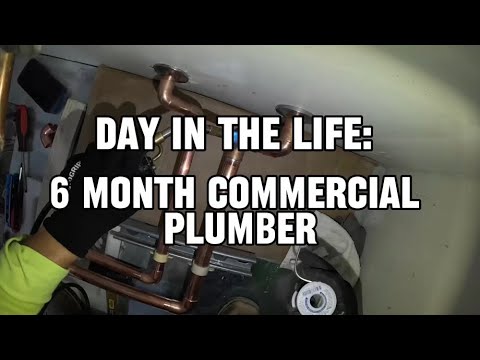
Photo: Frank Carter (Public domain)
Job description
Duties run from requisitioning tools and selecting the right pipe for a job to drilling or cutting holes through walls and floors to route it, then mounting brackets and hangers to support the finished run. Helpers also assist with rough-ins, replacing fixtures and water heaters, and locating and removing leaking or broken pipe. The work is mostly outdoors and physically demanding, giving newcomers hands-on exposure to the trade before pursuing a plumbing apprenticeship.
Pros
- Low barrier to entry with just a high school diploma and on-the-job training
- Faster than average projected job growth (4.9%) over the next decade
- Hands-on trade experience that builds directly toward a full plumber or pipefitter career
Cons
- Entry-level pay is on the lower end, with a modest ceiling around $58k
- Regular exposure to hazardous equipment, working at heights, and physically demanding tasks
- Full exposure to outdoor weather conditions on many job sites
A typical day
The day starts in a trench — literally — checking grade with a laser level so a new sewer line falls exactly a quarter inch per foot toward the main. The helper lowers pipe lengths to the pipelayer, swabs joints, and shovels bedding gravel around each set section. By midday the crew moves inside a renovation, where the helper cuts and deburrs copper, holds fittings steady for soldering, and learns why every joint gets cleaned and fluxed. There are supply-house runs, fixture boxes to unpack and stage, and a water heater to muscle up a basement stairway with straps and a partner. The shift ends pressure-testing the day's work and watching gauges hold steady — the trade's quiet victory.
Tasks at the job
- Requisition tools and equipment, select type and size of pipe, and collect and transport materials and equipment to work site.
- Cut or drill holes in walls or floors to accommodate the passage of pipes.
- Perform rough-ins, repair and replace fixtures and water heaters, and locate, repair, or remove leaking or broken pipes.
- Fit or assist in fitting valves, couplings, or assemblies to tanks, pumps, or systems, using hand tools.
- Mount brackets and hangers on walls and ceilings to hold pipes, and set sleeves or inserts to provide support for pipes.
- Disassemble and remove damaged or worn pipe.
Workplace & working conditions
Work happens primarily outdoors, exposed to whatever the weather is doing, and most of the day is spent on your feet. Noise levels can be distracting or uncomfortable. The role involves regular exposure to hazardous equipment or conditions and contaminants and working at heights, and standard protective equipment (gloves, safety glasses, and similar) is expected.
There's a regular, moderate amount of time pressure.
Education necessary or common
High school diploma; some on-the-job training or apprenticeship
Licenses & certifications
- OSHA 10-Hour Construction
- Registered plumbing apprenticeship — the paid path to journeyman license
- Trench safety/competent person training (later, valued on utility crews)
Career path
Related fields
Courses to take
- Plumbing or Building Trades (career/tech center) — some articulate into apprenticeship credit
- Algebra — pipe slope, volumes, and fitting takeoffs
- Geometry — offsets and angles are daily calculations
- Physics — water pressure, venting, and thermal expansion in practice
- Shop class — cutting, joining, and tool safety
Clubs, activities & competitions
- SkillsUSA — plumbing is a national competition category
- Habitat for Humanity — watch rough plumbing go into real houses
- Robotics or maker club — systems assembly practice
- Help with real repairs at home: swap a faucet, rebuild a toilet fill valve
First steps you can take now
- Fix one plumbing item at home this month with a guide — a running toilet teaches more than a video
- Look up your local UA (plumbers/pipefitters union) apprenticeship application windows
- Ask a plumbing company about helper positions — many hire at 18 with no experience
- Practice measuring and sketching the visible pipe runs in your basement to learn how systems connect