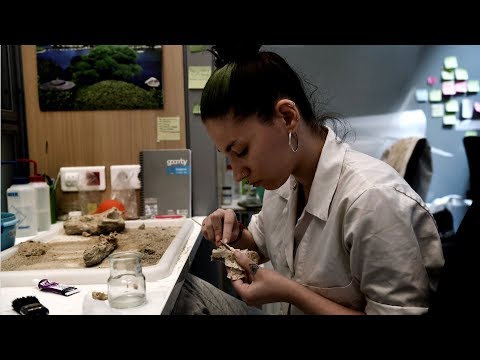
Photo: Andreas Reinecke (CC BY-SA 4.0)
Job description
Fieldwork can mean interviewing communities directly, observing daily life firsthand, or systematically recovering and examining physical evidence like tools and pottery from past civilizations, depending on whether the focus leans cultural or archeological. Findings get written up and presented to both academic audiences and the general public, and many anthropologists split their time teaching or mentoring students alongside their own research. Documentation methods have modernized well beyond notebooks, with photography, video, and audio recordings now standard for building a research record. Most positions in the field, especially research and academic roles, require a PhD, though a master's degree can support fieldwork-focused jobs.
Pros
- Faster than average projected job growth (3.7%) for a niche research field
- A master's degree can support fieldwork roles, without always requiring a full PhD
- Intellectually varied work spanning fieldwork, teaching, writing, and cultural research
Cons
- A relatively small number of positions nationwide (800) makes the job market competitive
- Above-average hours, often exceeding a standard 40-hour work week
- Academic and research leadership roles typically require a PhD, a long graduate training path
A typical day
Fieldwork season and office season are different jobs. On a summer dig, the day starts at 6 to beat the heat: troweling a one-meter excavation unit in careful layers, screening every bucket of soil, bagging and labeling a pottery sherd with its exact provenience because context is the science. Off-season, a cultural anthropologist's day might instead be interviews and participant observation — hours of recorded conversation later coded for patterns. Many working archeologists are in cultural resource management: surveying a pipeline corridor ahead of construction, then writing the compliance report that decides what happens next. The lab, the library, and the field trade places all year.
Tasks at the job
- Collect information and make judgments through observation, interviews, and review of documents.
- Teach or mentor undergraduate and graduate students in anthropology or archeology.
- Write about and present research findings for a variety of specialized and general audiences.
- Plan and direct research to characterize and compare the economic, demographic, health care, social, political, linguistic, and religious institutions of distinct cultural groups, communities, and organizations.
- Create data records for use in describing and analyzing social patterns and processes, using photography, videography, and audio recordings.
- Train others in the application of ethnographic research methods to solve problems in organizational effectiveness, communications, technology development, policy making, and program planning.
Workplace & working conditions
Work happens indoors in a climate-controlled setting, and most of the day is spent sitting at a desk.
There's a regular, moderate amount of time pressure, and you're expected to exercise significant independent judgment day to day. The work is highly structured, following set procedures.
Education necessary or common
Doctor of Philosophy (PhD) in anthropology or archeology for research and academic roles; a master's can support fieldwork positions
Common college majors
Licenses & certifications
- RPA (Register of Professional Archaeologists, later-career)
Career path
Related fields
Courses to take
- AP World History — deep-time context for human societies
- AP Biology — biological anthropology and human evolution
- AP Statistics — modern archeology is quantitative
- A world language — fieldwork often demands one
- AP English Language — the field runs on writing
Clubs, activities & competitions
- Model UN — cross-cultural systems thinking
- History or archaeology club (or start one)
- Museum volunteering — collections work is real experience
- Science Olympiad (Anthropology-adjacent events when offered)
First steps you can take now
- Ask a local museum or historical society about student volunteer roles in collections
- Attend a public archaeology day — many state archaeology offices host digs open to visitors
- Read one ethnography cover to cover and write what surprised you
- Look up your state's Archaeology Month events and go