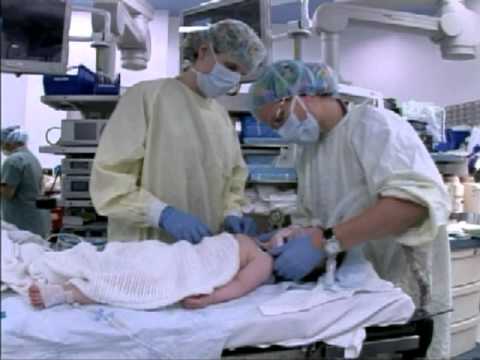
Photo: U.S. Navy photo by Mass Communication Specialist 2nd Class Candice Villarreal (Public domain)
Job description
Pediatric surgeons use exams and imaging to diagnose surgical conditions in young patients, then perform operations scaled to pediatric anatomy and physiology, a meaningfully different skill set than adult surgery. Because the patients themselves are often frightened and the parents anxious, explaining procedures and recovery in age-appropriate terms and managing everyone's nerves is as much a part of the job as the surgery itself. Surgeons coordinate closely with pediatric anesthesiologists and specialists on complex cases and watch for complications specific to pediatric recovery afterward, with emergencies able to arise alongside a full schedule of planned procedures.
Pros
- Exceptional earning ceiling up to $727k, among the highest-paid medical specialties
- Highly specialized, technically demanding surgical work built around a specific patient population
- Directly improves outcomes for the most vulnerable patients, a deeply meaningful area of medicine
Cons
- Requires an MD or DO plus lengthy residency training in a highly competitive surgical subspecialty
- Slower than average projected job growth, with current demand data showing effectively no growth in open positions
- Especially high emotional stakes given the vulnerability of young patients and the anxiety of their families
A typical day
The first case at 7:30am is a pyloromyotomy on a three-week-old — a stomach-outlet muscle split under magnification through an incision smaller than a paperclip, curing the baby's projectile vomiting permanently in twenty-five minutes. Pediatric surgery's defining truth operates all day: children are not small adults, and a preemie's tissue handles like wet tissue paper while a teenager's appendectomy feels almost routine by comparison. Between cases the surgeon rounds on the NICU babies — yesterday's bowel repair tolerating feeds, a good sign — and takes a prenatal consult, counseling parents whose unborn baby's diaphragmatic hernia will need surgery in its first days. The afternoon clinic runs hernia checks and post-ops with stickers deployed strategically. At 5pm the trauma pager fires: a bike-versus-car eight-year-old needs an exploratory laparotomy tonight. The stakes are entire lifetimes; the surgeons carry that math consciously.
Tasks at the job
- Diagnose surgical conditions in infants, children, and adolescents using exams and imaging.
- Perform surgeries adapted to the smaller anatomy and physiology of pediatric patients.
- Explain procedures, risks, and recovery in age-appropriate terms to both the child and family.
- Coordinate with pediatric anesthesiologists and specialists on complex cases.
- Monitor young patients post-operatively for complications specific to pediatric recovery.
- Manage the anxiety of parents and young patients throughout treatment.
Workplace & working conditions
Work happens in hospital operating rooms and pediatric surgical units equipped and scaled specifically for children.
The stakes are especially high given the vulnerability of young patients, and the work demands both surgical precision and skill in communicating with frightened children and anxious parents. Emergency pediatric cases can arise with little warning, alongside a schedule of planned procedures.
Education necessary or common
Doctor of Medicine (MD) or Doctor of Osteopathic Medicine (DO), plus residency training in the specialty
Common college majors
Licenses & certifications
- Medical license (MD/DO)
- American Board of Surgery certification plus Pediatric Surgery certification
Career path
Related fields
Courses to take
- AP Biology — the premed foundation
- Anatomy and Physiology — surgical anatomy begins here
- AP Chemistry — the prerequisite chain
- AP Psychology — communicating with children and terrified parents
- AP Statistics — outcomes literature and risk communication
Clubs, activities & competitions
- HOSA-Future Health Professionals
- Hospital or children's hospital volunteering
- Babysitting, camp counseling, youth coaching — genuine comfort with kids matters in this specialty
- Fine-motor hobbies — instrument hands are built over decades
First steps you can take now
- Volunteer with children in any capacity this semester and confirm you genuinely love working with them
- Shadow any surgeon or physician available to you
- Understand the path's length clearly: college, medical school, general surgery residency, then pediatric surgery fellowship — among medicine's longest and most competitive roads
- Read a pediatric surgeon's memoir to weigh the emotional stakes honestly