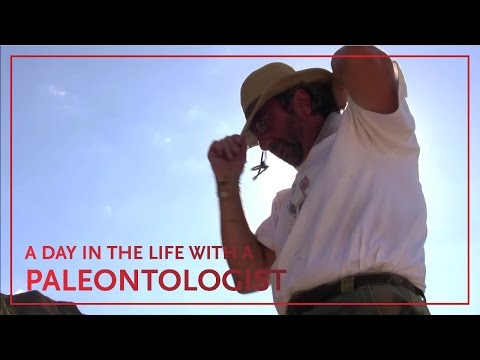
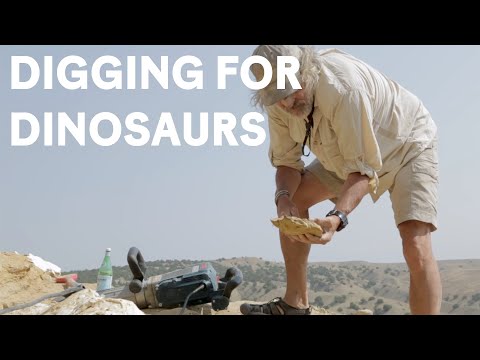
Photo: Hicks, William (CC BY 4.0)
Job description
Fieldwork means searching for and carefully extracting fossils, often in remote or rugged terrain, using specialized tools to avoid damaging fragile specimens. Back in the lab, paleontologists classify species, reconstruct evolutionary relationships, and prepare research for publication in academic journals or presentation at conferences, while also preparing specimens for museum display. Most work in academia, museums, or, for a smaller number, the oil and gas industry applying similar geological skills, and the job rewards patience since a real discovery can come only after days of unproductive digging.
Pros
- Chance to make genuine scientific discoveries about ancient life and evolution
- Mix of remote fieldwork and detailed museum or university lab work
- Pay can reach $100k, strong for a research-heavy science field
Cons
- PhD typically required to lead independent research, a long educational path
- Fieldwork means weeks in harsh desert, badlands, or arctic conditions
- Securing grant funding and permits is a constant, competitive requirement
A typical day
Field season means the day starts at 6am before desert heat arrives: the crew hikes to the quarry where a hadrosaur skeleton is emerging, and the morning is patient work with awls, brushes, and consolidant — an exposed femur mapped, photographed, and jacketed in plaster for the trip home. GPS coordinates and stratigraphic notes go into the field book, because a fossil without context is just a curiosity. Back at the museum the rest of the year, the day looks different: hours at the microscope preparing specimens, measurements fed into an evolutionary analysis, a graduate student's dissertation chapter reviewed, and an afternoon writing — the grant that funds next summer's dig, the paper describing last summer's find. A school group tours the lab at 3pm, and the paleontologist answers the eternal favorite question with practiced delight. The dead keep excellent company.
Tasks at the job
- Search for and excavate fossils in the field, often in remote or rugged terrain.
- Carefully extract and stabilize fossils using specialized tools to avoid damage.
- Analyze fossils in a lab to classify species and reconstruct evolutionary relationships.
- Publish research findings in academic journals and present at scientific conferences.
- Prepare fossil specimens for museum display or long-term storage.
- Secure grant funding and permits to support fieldwork and research projects.
Workplace & working conditions
Fieldwork takes place at remote outdoor excavation sites, sometimes for weeks in harsh desert, badlands, or arctic conditions, while much of the year is spent in a university or museum lab.
The work rewards patience over speed, since a fossil discovery may come after days of unproductive digging, and lab analysis demands painstaking precision when handling fragile, irreplaceable specimens.
Education necessary or common
PhD typically required for research positions; a bachelor's or master's can support museum or field technician roles
Common college majors
Career path
Related fields
Courses to take
- AP Biology — evolution is the field's organizing theory
- Earth Science or Geology — fossils live in rock; read the rock first
- AP Chemistry — dating methods and preservation chemistry
- AP Statistics — modern paleo runs on quantitative analysis
- AP English Language and Composition — science careers are writing careers
Clubs, activities & competitions
- Science Olympiad — Fossils is a literal event
- Rock and mineral club, or start a fossil collection with documented localities
- Museum volunteering — many natural history museums take teen volunteers in prep labs
- Science fair with a geology or comparative-anatomy project
First steps you can take now
- Find a legal fossil-collecting site in your state and collect properly — documented locality, careful extraction
- Compete in Science Olympiad's Fossils event using its free study lists
- Ask your nearest natural history museum about volunteer prep-lab or dig programs — several run public digs
- Read one real journal paper on a dinosaur discovery and trace how the claim is supported