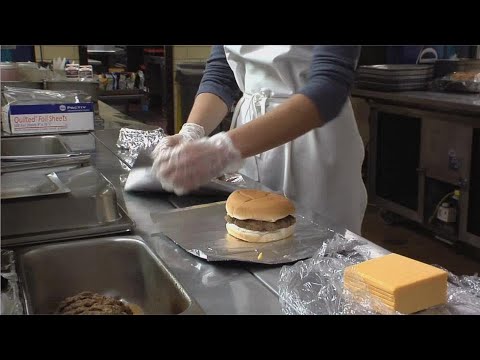
Photo: Department of Agriculture. Office of Governmental and Public Affairs. Photograph (Public domain)
Job description
The job runs on volume and schedule: cooking to a fixed menu, watching for allergy or dietary restrictions among the people being served, and logging food temperatures throughout the shift to stay within safety limits. It often includes directing one or more helpers with prep and service, plus rotating supplies and keeping the kitchen and equipment clean and functional. Because meals have to hit a fixed window, whether that's a school lunch bell or a hospital's meal service, the pace runs fast with firm deadlines that don't move.
Pros
- Employment projected to grow modestly (2%) over the next decade
- Low barrier to entry: just a high school diploma and on-the-job training
- Structured, predictable hours (40-45/week) tied to institutional meal schedules
Cons
- Limited upside on pay, with the top of the range under $50k
- Entry-level pay can be quite low
- Fast-paced work under real time pressure to hit fixed meal-service deadlines
A typical day
A school kitchen starts at 6am: ovens on, and 900 lunches to serve at 11:15 sharp. The morning is batch cooking at scale — sheet pans of chicken cycling through combi ovens, a 40-gallon kettle of marinara, temperatures probed and logged at every stage because the health inspector's standards are the floor, not the goal. Special diets get their own careful lane: the gluten-free tray, the allergy-alert plates matched to specific students. Service is fast and warm — you learn the kids' names. Afterward comes the reset: leftovers cooled correctly, deliveries rotated into storage, equipment inspected and cleaned, and tomorrow's thaw pulled. The hours — done by mid-afternoon, summers off in schools — are the quiet perk.
Tasks at the job
- Monitor and record food temperatures to ensure food safety.
- Cook foodstuffs according to menus, special dietary or nutritional restrictions, or numbers of portions to be served.
- Rotate and store food supplies.
- Clean and inspect galley equipment, kitchen appliances, and work areas to ensure cleanliness and functional operation.
- Wash pots, pans, dishes, utensils, or other cooking equipment.
- Direct activities of one or more workers who assist in preparing and serving meals.
Workplace & working conditions
Work happens indoors in a climate-controlled setting, and most of the day is spent on your feet. Noise levels can be distracting or uncomfortable. Standard safety equipment like gloves or safety glasses is commonly worn.
The pace is often fast, with real time pressure to meet deadlines. You'll regularly deal with frustrated or upset people as part of the job, and almost all of the work is done as part of a team.
Education necessary or common
High school diploma; some on-the-job training or apprenticeship
Licenses & certifications
- ServSafe Food Handler/Manager
- State food safety certification
Career path
Related fields
Courses to take
- Culinary Arts — batch technique starts with basic technique
- Health — nutrition and food safety are the daily framework
- Business Math — scaling recipes for hundreds
- Family and Consumer Sciences
Clubs, activities & competitions
- FCCLA — culinary and nutrition events
- School cafeteria student worker programs where offered
- Volunteer cooking at a shelter, church, or community kitchen
- ProStart program if your school has it
First steps you can take now
- Volunteer to cook at a community meal — feel what fifty portions takes
- Get ServSafe Food Handler certified online
- Scale a family recipe to 20 servings and document what changed
- Ask your school's kitchen manager for a behind-the-scenes look