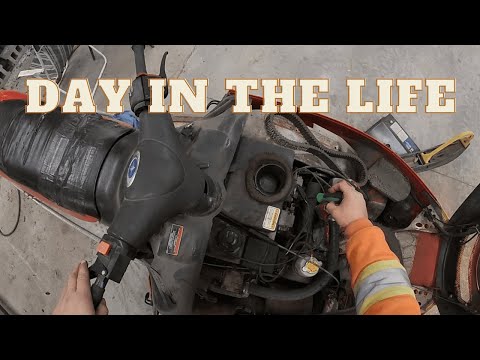
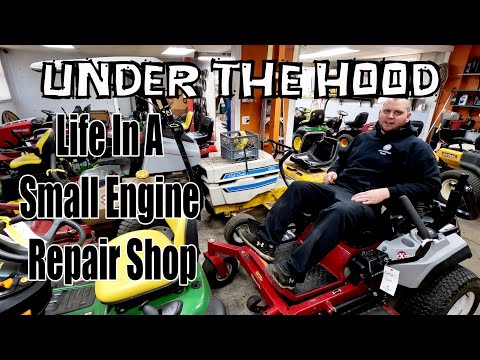
Photo: Shixart1985 (CC BY 2.0)
Job description
A repair usually starts with testing and inspecting an engine to track down missing or broken parts, then adjusting carburetors, valves, and spark plug gaps with feeler gauges before reassembling and test-running the machine. Mechanics also handle routine maintenance like cleaning parts, honing cylinders, and tuning ignition systems. Because the work spans everything from mowers to chain saws to recreational equipment, schedules often get busier with the lawn-care and outdoor-recreation seasons, and many mechanics work at small independent shops or dealerships, sometimes eventually opening their own.
Pros
- Accessible entry with just a high school diploma and on-the-job training
- Steady demand with about 3,500 positions and modest ongoing growth
- Hands-on mechanical troubleshooting on a wide range of small engines
Cons
- Above-average hours, often exceeding a standard 40-hour work week
- Pay ceiling is lower than other mechanic trades, topping out around $67k
- Regular exposure to hazardous equipment and shop noise
A typical day
Spring is the season that pays for winter, and the shop shows it: fourteen mowers on the rack by 8am. The first is a no-start diagnosed in minutes — stale fuel varnishing the carburetor, cleaned ultrasonically and back together within the hour. A commercial crew's zero-turn gets priority; landscapers lose money every hour it sits, so the hydro drive gets its slipped belt and a blade balance while the customer waits. Mid-morning brings the interesting one: a chainsaw with a scored piston telling a straight-gas story its owner reluctantly confirms. The afternoon is rhythm work — tune-ups, blade sharpening, a string-trimmer clutch, and a generator carb rebuild — plus parts ordering, where knowing every engine family's quirks makes the difference. Fall will bring the same shop full of snowblowers. Small engines, honest work, steady demand.
Tasks at the job
- Test and inspect engines to determine malfunctions, to locate missing and broken parts, and to verify repairs, using diagnostic instruments.
- Repair and maintain gasoline engines used to power equipment such as portable saws, lawn mowers, generators, and compressors.
- Adjust points, valves, carburetors, distributors, and spark plug gaps, using feeler gauges.
- Repair or replace defective parts such as magnetos, water pumps, gears, pistons, and carburetors, using hand tools.
- Perform routine maintenance such as cleaning and oiling parts, honing cylinders, and tuning ignition systems.
- Reassemble engines after repair or maintenance work is complete.
Workplace & working conditions
Work happens indoors, though not always in a climate-controlled space, and most of the day is spent on your feet. Noise levels can be distracting or uncomfortable. The role involves regular exposure to hazardous equipment or conditions and contaminants, and standard protective equipment (gloves, safety glasses, and similar) is expected.
There's a regular, moderate amount of time pressure, and you're expected to exercise significant independent judgment day to day.
Education necessary or common
High school diploma; some on-the-job training or apprenticeship
Licenses & certifications
- EETC certification (Equipment and Engine Training Council)
- Manufacturer certifications (Briggs and Stratton, Kohler, Stihl)
Career path
Related fields
Courses to take
- Small Engine Repair or Auto Shop CTE courses — the direct pathway, offered widely
- Physics — combustion, compression, and electrical basics
- Algebra — mixture ratios, specs, and pricing math
- Business — many small-engine mechanics eventually own the shop
- Welding — brackets, decks, and repairs
Clubs, activities & competitions
- SkillsUSA — power equipment technology competitions
- FFA — small engines is a national competitive event
- Rebuild projects at home: a free non-running mower is the classic teacher
- Lawn-care side business — running the equipment you'll someday fix
First steps you can take now
- Get a free broken mower from a curb or marketplace and revive it this month with videos and a carb kit
- Take your school's small-engine class or an FFA engines program
- Ask a local equipment dealer about seasonal helper jobs — spring hiring is real
- Learn two-stroke versus four-stroke fundamentals cold