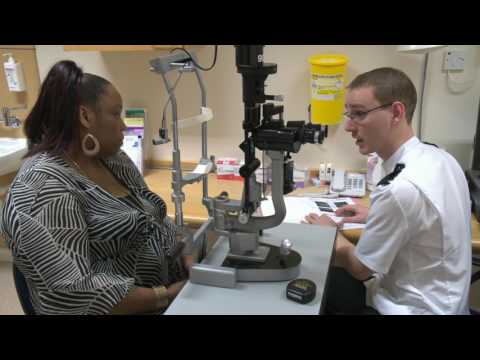
Photo: U.S. Air Force photo by Andrea Jenkins (Public domain)
Job description
Working closely with ophthalmologists, orthoptists run tests like motor testing, visual acuity checks, and retinoscopy to pin down conditions such as strabismus, amblyopia, and nystagmus. Rather than operating, they build nonsurgical treatment plans, corrective lenses, eye patches, or vision therapy exercises, and explain these directly to patients and families. The role is typically based in an ophthalmology practice or hospital eye clinic, working alongside surgeons who take on any cases that do need an operation.
Pros
- High upside earning potential up to $195k
- Enters the field with a bachelor's degree plus fellowship, a shorter path than most eye-care doctoral tracks
- Focused, specialized niche in binocular vision and eye movement disorders
Cons
- Slower than average projected job growth (2%)
- A relatively small number of positions nationwide, so opportunities may be geographically limited
- Narrow scope of practice compared to a full optometrist or ophthalmologist
A typical day
The first patient at 8:30am is a four-year-old with esotropia — one eye turning inward — and the orthoptist's exam is detective work disguised as play: prism bars measuring the deviation while the child watches a cartoon target, cover tests revealing what each eye does when it thinks nobody's looking, and stereopsis testing that shows whether the brain is fusing two images or suppressing one. The morning's cases include an amblyopia follow-up where patching compliance gets troubleshot with a parent (sticker charts work better than lectures), and an adult with sudden double vision whose measurements will help the ophthalmologist locate the cause. After lunch the orthoptist works up surgical candidates — precise angle measurements the strabismus surgeon will operate from — and fits a prism into a patient's glasses that makes her double vision vanish in the chair. Small patients, patient science, visible wins.
Tasks at the job
- Examine patients with problems related to ocular motility, binocular vision, amblyopia, or strabismus.
- Evaluate, diagnose, or treat disorders of the visual system with an emphasis on binocular vision or abnormal eye movements.
- Provide instructions to patients or family members concerning diagnoses or treatment plans.
- Perform diagnostic tests or measurements, such as motor testing, visual acuity testing, lensometry, retinoscopy, and color vision testing.
- Provide nonsurgical interventions, including corrective lenses, patches, drops, fusion exercises, or stereograms, to treat conditions such as strabismus, heterophoria, and convergence insufficiency.
- Develop nonsurgical treatment plans for patients with conditions such as strabismus, nystagmus, and other visual disorders.
Workplace & working conditions
Work happens indoors in a climate-controlled setting, and you work in close physical proximity to coworkers or the public for much of the shift.
There's a regular, moderate amount of time pressure, and you're expected to exercise significant independent judgment day to day. Precision and accuracy are essential to the work. You'll regularly deal with frustrated or upset people as part of the job, and almost all of the work is done as part of a team.
Education necessary or common
Bachelor's degree plus completion of an accredited orthoptic fellowship program
Common college majors
Licenses & certifications
- Certified Orthoptist (CO, American Orthoptic Council)
Career path
Related fields
Courses to take
- Anatomy and Physiology — the visual system in depth
- AP Biology — neural development and the science core
- AP Psychology — child development and testing behavior
- Physics — optics and prisms are daily tools
- Child Development courses — most patients are small and squirmy
Clubs, activities & competitions
- HOSA-Future Health Professionals
- Volunteer with children — camps, tutoring, pediatric hospital programs
- Vision screening volunteering (school and Lions Club programs)
- Science Olympiad — anatomy and optics events
First steps you can take now
- Look up the orthoptic fellowship path — a bachelor's degree plus a two-year accredited program, a hidden-gem healthcare career few students know exists
- Shadow in a pediatric ophthalmology clinic where orthoptists work
- Volunteer at a children's vision screening
- Read about amblyopia and strabismus basics to speak the field's language