Photo: Leadingtopunion (CC0)
Job description
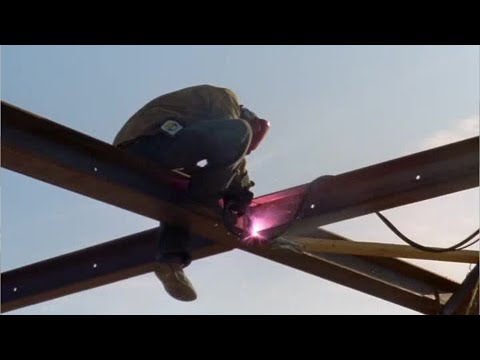
Fitters lay out and examine metal stock against blueprints to confirm specifications, then position, align, and tack-weld parts into place before finishing them with a full weld. They also set up and run fabricating machines like brakes, rolls, shears, and flame cutters to bend, cut, and drill components ahead of assembly, moving heavier pieces into position with hoists or cranes. Because the finished product often becomes part of a larger structure, such as a building frame or industrial support system, precision at each fitting stage affects how well the whole assembly comes together on-site.
Pros
- Low barrier to entry: just a high school diploma with on-the-job training or apprenticeship
- Hands-on fabrication and welding work building large-scale structural components
- Varied use of tools and machines, from hand welding to operating brakes, rolls, and shears
Cons
- Employment projected to shrink sharply over the next decade (-16.3%)
- Above-average hours, often exceeding a standard 40-hour work week
- Regular exposure to hazardous equipment and contaminants during welding and fabrication
A typical day
The shift opens at the print table, studying the blueprint for a run of support brackets and marking the cut list. The morning is spent at the saw and press brake -- cutting plate, punching holes, and bending flanges to the drawing's tolerances, with calipers out constantly. After lunch comes fit-up: clamping parts into a jig, checking squareness, and tack-welding assemblies so the certified welder can run final beads. The last hour is quality checks and grinding, because a part that's a sixteenth off here becomes a problem someone else inherits downstream.
Tasks at the job
- Verify conformance of workpieces to specifications, using squares, rulers, and measuring tapes.
- Position, align, fit, and weld parts to form complete units or subunits, following blueprints and layout specifications, and using jigs, welding torches, and hand tools.
- Lay out and examine metal stock or workpieces to be processed to ensure that specifications are met.
- Tack-weld fitted parts together.
- Move parts into position, manually or with hoists or cranes.
- Set up and operate fabricating machines, such as brakes, rolls, shears, flame cutters, grinders, and drill presses, to bend, cut, form, punch, drill, or otherwise form and assemble metal components.
Workplace & working conditions
Work happens indoors, though not always in a climate-controlled space, and most of the day is spent on your feet. Noise levels can be distracting or uncomfortable. The role involves regular exposure to hazardous equipment or conditions and contaminants, and standard protective equipment (gloves, safety glasses, and similar) is expected.
The pace is often fast, with real time pressure to meet deadlines. Precision and accuracy are essential to the work.
Education necessary or common
High school diploma; some on-the-job training or apprenticeship
Licenses & certifications
- AWS welding certifications
- OSHA 10
- NCCER credentials
Career path
Related fields
Courses to take
- Welding or metal shop -- the trade's core skills, learnable now
- Geometry -- flat patterns, bend allowances, and squareness
- Drafting or CAD -- fabricators live inside blueprints
- Algebra -- tolerances and material math
- Physics -- why metal springs back when you bend it
Clubs, activities & competitions
- SkillsUSA welding and fabrication competitions
- FIRST Robotics -- real fabrication for the robot chassis
- Auto shop or metal shop projects
- A summer job at a fab or machine shop
First steps you can take now
- Take a metal shop or intro welding class this year
- Learn to read a blueprint -- free tutorials cover views, dimensions, and tolerances
- Take the free OSHA 10 general industry course
- Visit a local fabrication shop and ask what entry-level helpers do