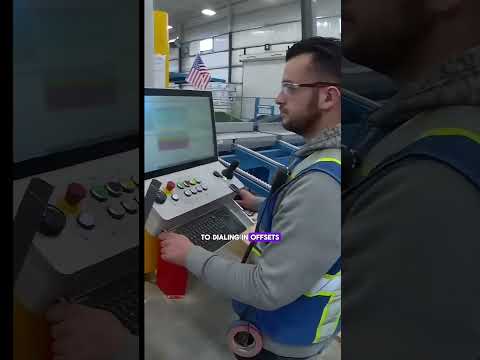
Photo: Staff Sgt. Elysia Wray, U.S. Air Force (Public domain)
Job description
Before a machine even starts cutting, an operator has to study the blueprint or job order to work out dimensions, tooling, and the right sequence of operations, then set a zero reference point and confirm the workpiece is properly aligned using a dial indicator. Once everything checks out, they engage the automatic feed to drill, bore, or ream the piece, then verify the finished work against spec with calipers, micrometers, or gauges before moving to the next one. Cutting tools wear down and need regular swapping, and because a misaligned setup can scrap an entire piece, the work rewards patience during setup even though the shop floor itself runs at a fast, deadline-driven pace. It's typically learned through on-the-job training rather than a degree, and demand for the role has fallen sharply as more of this work moves to automated and CNC systems.
Pros
- Pay can reach over $68k with experience, above many entry-level trades
- No degree required, just a high school diploma and on-the-job training
- Precision machining work with real independent judgment in adjusting setups
Cons
- Employment projected to shrink sharply over the next decade (-19.6%)
- Only about 400 jobs nationwide, making positions scarce and geographically limited
- Above-average hours, often more than a standard 40-hour week
A typical day
The job order calls for five hundred flange plates, each needing four holes bored, reamed, and countersunk to a tolerance the blueprint states plainly: the morning is setup — the right bits selected and mounted, workpiece clamped and aligned with a dial indicator until the reference lines run true, feeds and speeds set for the alloy on the table. The first piece gets measured with calipers and a telescoping gauge before the run continues; the machine does the repetition, but the operator owns the verification, pulling parts at intervals because bits wear and holes drift. A bit change mid-shift on a harder batch of stock, chips cleared, coolant checked. The satisfaction is a pallet of parts, every hole where the print says, ready for the assembly line that trusts this station without thinking about it.
Tasks at the job
- Verify conformance of machined work to specifications, using measuring instruments, such as calipers, micrometers, or fixed or telescoping gauges.
- Study machining instructions, job orders, or blueprints to determine dimensional or finish specifications, sequences of operations, setups, or tooling requirements.
- Move machine controls to lower tools to workpieces and to engage automatic feeds.
- Verify that workpiece reference lines are parallel to the axis of table rotation, using dial indicators mounted in spindles.
- Establish zero reference points on workpieces, such as at the intersections of two edges or over hole locations.
- Change worn cutting tools, using wrenches.
Workplace & working conditions
Work happens indoors in a climate-controlled setting, and most of the day is spent on your feet. Noise levels can be distracting or uncomfortable. The role involves regular exposure to hazardous equipment or conditions and contaminants, and standard protective equipment (gloves, safety glasses, and similar) is expected.
The pace is often fast, with real time pressure to meet deadlines, and you're expected to exercise significant independent judgment day to day. Precision and accuracy are essential to the work.
Education necessary or common
High school diploma; some on-the-job training or apprenticeship
Licenses & certifications
- NIMS machining credentials
- OSHA 10
Career path
Related fields
Courses to take
- Machine Shop — the direct preparation
- Geometry — holes, axes, and alignment
- Algebra — feeds, speeds, and tolerances
- Drafting — blueprint literacy is the job's reading requirement
- Physics — cutting forces and material behavior
Clubs, activities & competitions
- SkillsUSA precision machining
- FIRST Robotics — drilling and machining robot parts
- TSA manufacturing events
- Maker space or shop hobby work
First steps you can take now
- Take shop class and learn drill press fundamentals properly
- Learn to measure with calipers and micrometers accurately
- Get OSHA 10 certified online
- Visit a machine shop and ask what entry operators need to know