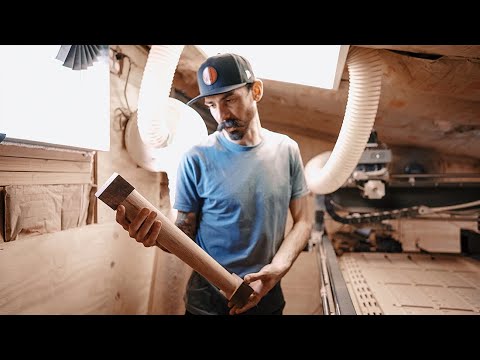
Photo: Dschamal Berger (CC BY-SA 4.0)
Job description
Operators start machines, adjust controls, and make trial cuts to confirm everything's working before feeding stock through planing, shaping, boring, or sanding machines to produce finished components. Part of the job is mechanical upkeep: installing and adjusting blades, cutterheads, or sanding belts, and inspecting pulleys, drive belts, and guards to make sure machines run safely. It's standing, hands-on work in a shop that isn't always climate-controlled, with steady noise exposure and a premium on precision even under moderate time pressure.
Pros
- Low barrier to entry with just a high school diploma and on-the-job training
- Hands-on production work with a fairly large number of positions nationwide (6,400)
- Precision-focused machine work that builds transferable skilled-trade experience
Cons
- Job growth projected to shrink slightly (-1.8%) over the next decade
- Regular exposure to hazardous equipment like blades, cutterheads, and sanding belts
- Facility isn't always climate-controlled, so conditions vary with weather and shop setup
A typical day
The shift starts at the CNC router with a job packet: cabinet parts nested onto sheets, program loaded, and the first sheet's parts measured against the drawing before the machine earns trust for the run. The morning splits attention across machines -- feeding the shaper, watching the sander's feed rate on figured stock that burns easily. A router bit's edge going dull announces itself in the cut quality first, and catching it early saves a stack of parts. The afternoon is a changeover to a new profile: knives set, test cuts measured, and the run dialed in, with dust collection checked because fine dust is the shop's quiet hazard.
Tasks at the job
- Start machines, adjust controls, and make trial cuts to ensure that machinery is operating properly.
- Secure woodstock against a guide or in a holding device, place woodstock on a conveyor, or dump woodstock in a hopper to feed woodstock into machines.
- Inspect pulleys, drive belts, guards, or fences on machines to ensure that machines will operate safely.
- Monitor operation of machines and make adjustments to correct problems and ensure conformance to specifications.
- Install and adjust blades, cutterheads, boring-bits, or sanding-belts, using hand tools and rules.
- Feed stock through feed mechanisms or conveyors into planing, shaping, boring, mortising, or sanding machines to produce desired components.
Workplace & working conditions
Work happens indoors, though not always in a climate-controlled space, and most of the day is spent on your feet. Noise levels can be distracting or uncomfortable. The role involves regular exposure to hazardous equipment or conditions and contaminants, and standard protective equipment (gloves, safety glasses, and similar) is expected.
There's a regular, moderate amount of time pressure. Precision and accuracy are essential to the work.
Education necessary or common
High school diploma; some on-the-job training or apprenticeship
Licenses & certifications
- OSHA 10
- Woodwork Career Alliance credentials (where offered)
Career path
Related fields
Courses to take
- Woodworking/shop -- material knowledge transfers to machines
- Geometry -- profiles, offsets, and nesting
- Computer applications or CAD -- CNC work is programming-adjacent
- Algebra -- feeds, speeds, and measurements
- Physics -- cutting forces and machine behavior
Clubs, activities & competitions
- SkillsUSA cabinetmaking and CNC events
- School makerspace CNC and laser work
- FIRST Robotics fabrication
- Woodworking projects at home
First steps you can take now
- Learn a free CAM basics tutorial (like for a hobby CNC) to see how parts become toolpaths
- Take every shop class available
- Take the free OSHA 10 course
- Visit a cabinet or millwork shop and watch the machine room run