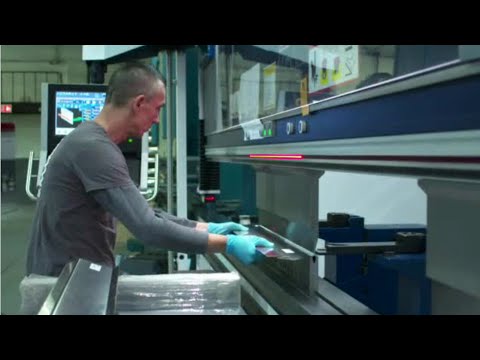
Photo: GodeNehler (CC BY-SA 4.0)
Job description
Whatever the material, the core job stays the same: load and run the machine, watch for jams or malfunctions, and adjust the speed, pressure, or alignment as needed to keep output on spec. Operators also weigh and measure finished pieces against requirements, then remove and stack completed material for the next stage of production. It's steady, standing production work where catching a small equipment problem early prevents a bigger shutdown later, typically learned through a high school diploma and on-the-job training.
Pros
- Around 5,300 positions nationwide, a moderately available production role
- No degree needed, just a high school diploma and on-the-job training
- Varied material work, from glass and rubber to food and paper products
Cons
- Above-average hours, often more than a standard 40-hour week
- Employment projected to shrink slightly over the next decade (-2.3%)
- Physically demanding, on-your-feet work with regular exposure to hazardous equipment
A typical day
Setup is the skilled half of the job: the morning's changeover from one product to another means new blades, adjusted guides, and test cuts measured with a micrometer until the slices land inside tolerance. Once the machine runs, the operator's attention divides — watching the cut quality, feeding or monitoring the material supply, catching the drift when blades warm up and dimensions creep. Food lines add washdown sanitation; glass and stone add dust control and handling care; rubber and insulation add their own quirks — every material teaches its own lessons. Samples get pulled and measured on schedule, the numbers logged. A jam or an off-spec run means stopping fast and diagnosing: blade, feed, or material. The best operators hear a problem before the gauges show it.
Tasks at the job
- Set up, operate, or tend machines that cut or slice materials, such as glass, stone, cork, rubber, tobacco, food, paper, or insulating material.
- Examine, measure, and weigh materials or products to verify conformance to specifications, using measuring devices, such as rulers, micrometers, or scales.
- Press buttons, pull levers, or depress pedals to start and operate cutting and slicing machines.
- Monitor operation of cutting or slicing machines to detect malfunctions or to determine whether supplies need replenishment.
- Adjust machine controls to alter position, alignment, speed, or pressure.
- Remove completed materials or products from cutting or slicing machines, and stack or store them for additional processing.
Workplace & working conditions
Most of the day is spent on your feet. Noise levels can be distracting or uncomfortable. The role involves regular exposure to hazardous equipment or conditions and contaminants, and standard protective equipment (gloves, safety glasses, and similar) is expected.
There's a regular, moderate amount of time pressure. Precision and accuracy are essential to the work.
Education necessary or common
High school diploma; some on-the-job training or apprenticeship
Licenses & certifications
- OSHA 10
- Food safety certification for food processing lines
Career path
Related fields
Courses to take
- Shop/Industrial Tech — machine comfort and tool sense
- Geometry — dimensions and tolerances
- Algebra — settings, rates, and conversions
- Physical Science — material behavior under cutting
Clubs, activities & competitions
- SkillsUSA manufacturing tracks
- Robotics club
- Part-time production or warehouse work
- Maker space membership — machine time of any kind
First steps you can take now
- Take a shop or manufacturing class and learn measurement tools properly
- Complete a free OSHA 10 general industry course
- Tour a local manufacturer on a community day
- Learn to read calipers and a micrometer