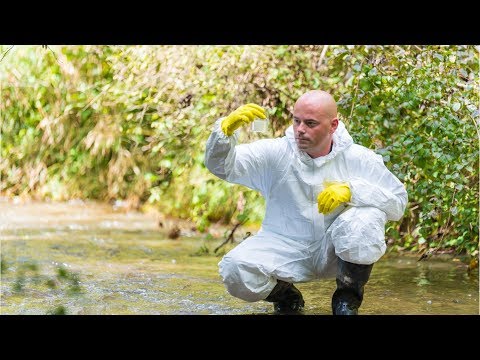
Photo: USAFRICOM from Stuttgart, Germany (CC BY 2.0)
Job description
Samples come from a wide range of sources, gases, soil, water, industrial wastewater, even asbestos products, and technicians also respond directly to hazardous spills or disease outbreaks, collecting samples on-site for analysis. Back in the lab, that raw data becomes a report, chart, or summary that gets discussed directly with whichever client or agency requested the testing. Technicians also inspect workplaces themselves, checking for hazards like high noise levels, radiation, or poor lighting. The pace is often fast with real deadlines to hit, and dealing with frustrated people, especially when results are unwelcome, is a regular part of the job.
Pros
- Pay can reach $94k+ for experienced technicians in environmental and public health testing
- Faster than average projected job growth (4% over the next decade)
- Varied work spanning lab testing, field sample collection, and hazard investigation
Cons
- Requires a bachelor's degree despite being a technician-level support role
- Regular exposure to contaminants during sample collection and hazard investigations
- Fast pace with real time pressure, especially when responding to spills or outbreaks
A typical day
Fieldwork starts early: pulling water samples from three river stations before the day warms, logging temperature and pH on site and packing bottles in ice for the lab. Late morning the technician responds to a spill report, walking a ditch line with a photoionization detector and collecting soil in labeled jars. Afternoon is lab and desk time — running turbidity and coliform tests, entering results into the state database, and flagging one reading that jumped enough to warrant a resample tomorrow. The steel-toe boots and the lab coat both get used most days.
Tasks at the job
- Collect samples of gases, soils, water, industrial wastewater, or asbestos products to conduct tests on pollutant levels or identify sources of pollution.
- Investigate hazardous conditions or spills or outbreaks of disease or food poisoning, collecting samples for analysis.
- Record test data and prepare reports, summaries, or charts that interpret test results.
- Prepare samples or photomicrographs for testing and analysis.
- Discuss test results and analyses with customers.
- Inspect workplaces to ensure the absence of health and safety hazards, such as high noise levels, radiation, or potential lighting hazards.
Workplace & working conditions
Work happens indoors in a climate-controlled setting. The role involves regular exposure to contaminants, and standard protective equipment (gloves, safety glasses, and similar) is expected.
The pace is often fast, with real time pressure to meet deadlines. You'll regularly deal with frustrated or upset people as part of the job.
Education necessary or common
Bachelor's degree
Common college majors
Licenses & certifications
- HAZWOPER 40-hour for spill and site work
- OSHA 10
- State water/wastewater sampling certifications where applicable
Career path
Related fields
Courses to take
- Chemistry — sampling and testing is bench chemistry with consequences
- AP Environmental Science — the framework for everything you will measure
- AP Biology — coliform counts and bioassessment start here
- Algebra II — dilutions, conversions, and detection limits are daily math
- Computer Applications — data entry and reporting are half the job
Clubs, activities & competitions
- Envirothon — the closest competition to this exact skill set
- A volunteer stream-monitoring team (Izaak Walton League and many states run them)
- Science Olympiad water quality event
- Science fair with a real field-sampling project
First steps you can take now
- Join a citizen water-quality monitoring program and learn proper sampling technique
- Test a local pond or stream with a kit and keep a rigorous field notebook
- Tour a water treatment plant or state environmental lab
- Look up environmental science technology programs at nearby community colleges