Photo: Johnnyschwerer (CC BY-SA 4.0)
Job description
A technician starts by reading a prescription or examining an impression to determine what needs to be built, then melts metals or mixes plaster, porcelain, or acrylic and pours the material into molds to form crowns, bridges, or dentures. Finishing work includes polishing surfaces and testing each piece against exact specifications using articulators and micrometers before it goes back to the dental office. With experience, technicians often move into training or supervising other lab staff, and because the pace is fast and precision essential, accuracy checks happen at every stage of production.
Pros
- Skilled craft work building dentures, crowns, and appliances by hand with no four-year degree required
- Clear path to supervising or training other technicians as experience grows
- Structured, desk-based work with predictable 40-45 hour weeks
Cons
- Field projected to shrink 4.7% over the next decade
- Precision-driven, highly structured work leaves little room for error under real deadline pressure
- Regular exposure to hazardous equipment, chemicals like acrylic pastes, and other contaminants
A typical day
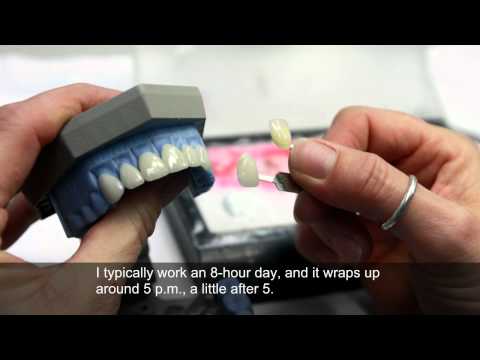
The morning cases sit in labeled pans: a crown prescription with a shade tab and a digital scan, a denture repair promised by Friday, a partial framework back from the casting stage. The crown gets built first — the die trimmed, the coping designed on screen or waxed by hand, porcelain layered and fired in the oven until the shade matches the tab under three different lights, because a front tooth that's slightly wrong is completely wrong. Precision instruments run all day: articulators checking the bite, micrometers verifying thickness, polishing wheels bringing surfaces to gloss. The dentist calls about a rush case; the schedule bends. Patients never see this room, but every confident smile that leaves the practice was manufactured here, by hand, to a tenth of a millimeter.
Tasks at the job
- Train or supervise other dental technicians or dental laboratory bench workers.
- Read prescriptions or specifications and examine models or impressions to determine the design of dental products to be constructed.
- Test appliances for conformance to specifications and accuracy of occlusion, using articulators and micrometers.
- Remove excess metal or porcelain and polish surfaces of prostheses or frameworks, using polishing machines.
- Fabricate, alter, or repair dental devices, such as dentures, crowns, bridges, inlays, or appliances for straightening teeth.
- Melt metals or mix plaster, porcelain, or acrylic pastes and pour materials into molds or over frameworks to form dental prostheses or apparatuses.
Workplace & working conditions
Work happens indoors in a climate-controlled setting, and most of the day is spent sitting at a desk. Noise levels can be distracting or uncomfortable. The role involves regular exposure to hazardous equipment or conditions and contaminants, and standard protective equipment (gloves, safety glasses, and similar) is expected.
The pace is often fast, with real time pressure to meet deadlines, and you're expected to exercise significant independent judgment day to day. Precision and accuracy are essential to the work, and the work is highly structured, following set procedures.
Education necessary or common
High school diploma; some on-the-job training or apprenticeship
Licenses & certifications
- Certified Dental Technician (CDT, through NBC)
- Specialty certifications by discipline (crowns, dentures, orthodontics)
Career path
Related fields
Courses to take
- Art (sculpture/ceramics) — this is sculpture at millimeter scale
- Chemistry — porcelains, resins, and metal alloys
- Biology — teeth and occlusion basics
- Shop — hand-tool precision and craft discipline
- Geometry — spatial reasoning in three dimensions
Clubs, activities & competitions
- Art club — sculpture and detail work
- SkillsUSA — some states run dental lab-adjacent competitions
- Model building, jewelry making, or miniature painting hobbies — directly relevant hand skills
- HOSA
First steps you can take now
- Sculpt something tiny and precise this month — a tooth from carving wax is the classic exercise
- Ask a local dental lab for a tour; most people never see one and labs enjoy showing off
- Watch crown build videos to see the craft at full speed
- Look up CODA-accredited dental lab technology programs