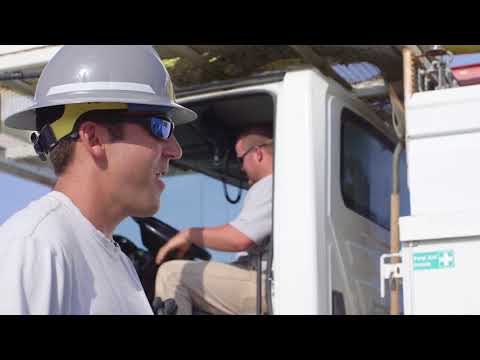
Photo: Daniel Case (CC BY-SA 3.0)
Job description
Much of the job happens outdoors in whatever weather shows up: driving to job sites, inspecting and testing power lines with specialized equipment, and opening switches or attaching grounding devices to make disturbed or fallen lines safe to work on. Some travel by truck, helicopter, or plane just to inspect lines for damage or insulation problems along a route. Because a mistake with live power lines can have serious consequences, the job demands sharp independent judgment under real time pressure, and it's typically learned through an apprenticeship or on-the-job training rather than a four-year degree.
Pros
- Top pay reaches nearly $129k, among the highest in the trades, without a four-year degree
- Faster than average projected job growth at 6.6% over the next decade
- Strong sense of purpose restoring power for communities after outages
Cons
- Above-average hours, often exceeding a standard 40-hour work week
- High-stakes work at heights around live electrical hazards where mistakes can be serious
- Outdoor work in all weather, sometimes during storm emergencies
A typical day
Storm season shows the job at full intensity, but an ordinary day has its own weight: the crew rolls at 7 with a work order to replace a failing transformer, and the first act is always the same — the line de-energized, tested dead, and grounded, because the safety ritual is the entire culture and everyone home for dinner is the only acceptable outcome. The climb or the bucket follows: forty feet up, tools on lanyards, the transformer swapped with a crane assist and connections made with practiced economy. The afternoon brings service work — a new home connected, a sagging span re-tensioned, an inspection route where binoculars find a cracked insulator before it becomes an outage. When storms do hit, everything changes: sixteen-hour days restoring power line by line, communities cheering the trucks, and the profound satisfaction of lights coming back on block by block. The trade pays well because it asks much.
Tasks at the job
- Adhere to safety practices and procedures, such as checking equipment regularly and erecting barriers around work areas.
- Drive vehicles equipped with tools and materials to job sites.
- Open switches or attach grounding devices to remove electrical hazards from disturbed or fallen lines or to facilitate repairs.
- Inspect and test power lines and auxiliary equipment to locate and identify problems, using reading and testing instruments.
- Coordinate work assignment preparation and completion with other workers.
- Travel in trucks, helicopters, and airplanes to inspect lines for freedom from obstruction and adequacy of insulation.
Workplace & working conditions
Work happens primarily outdoors, exposed to whatever the weather is doing, and most of the day is spent on your feet, and you work in close physical proximity to coworkers or the public for much of the shift. Noise levels can be distracting or uncomfortable. The role involves regular exposure to hazardous equipment or conditions and contaminants and working at heights, and specialized protective equipment is standard.
The pace is often fast, with real time pressure to meet deadlines, and you're expected to exercise significant independent judgment day to day. Mistakes can have serious consequences, so accuracy matters a lot. You'll regularly deal with frustrated or upset people as part of the job, and almost all of the work is done as part of a team.
Education necessary or common
High school diploma; some on-the-job training or apprenticeship
Licenses & certifications
- Line worker apprenticeship (IBEW/utility, ~4 years)
- CDL Class A
- OSHA 10
- First Aid/CPR/pole-top rescue
Career path
Related fields
Courses to take
- Physics — electricity at lethal scale demands understanding
- Algebra — load and tension calculations
- PE/Weight Training — the job is strength and endurance at height
- Shop — tool skills and mechanical sense
- Driver's Education — CDL path starts with good habits
Clubs, activities & competitions
- Sports — physical conditioning matters here
- SkillsUSA electrical tracks
- Climbing gym — comfort at height is testable early
- Utility career days and line camps some utilities run for students
First steps you can take now
- Look up your utility's or IBEW's line apprenticeship requirements
- Build real fitness — pole-top rescue is part of the physical exam
- Get comfortable with heights deliberately: climbing gym, ropes course
- Talk to a lineworker about storm duty and apprenticeship life honestly