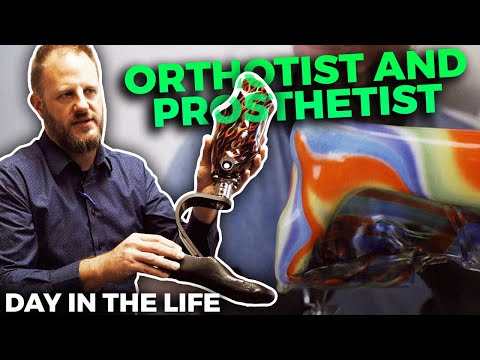
Photo: Ness Kerson/madNESS Photography for AusAID (CC BY-SA 4.0)
Job description
A case starts with examining and measuring a patient to understand their condition and daily needs, then designing a device, selecting materials and components, and either fabricating it or overseeing its fabrication. Getting the fit right often takes several follow-up visits of adjustment for comfort and function, and orthotists instruct patients on how to use and care for their device. Many build a specialty, such as pediatric limbs or spinal orthoses, and work settings range from hospital-based clinics to independent prosthetics practices.
Pros
- Much faster than average projected growth (13.3%) in a specialized, hard-to-replace clinical niche
- Strong pay ceiling (up to $120k) for a role combining hands-on craftsmanship with patient care
- Directly restores mobility and function for patients, blending design work with medicine
Cons
- Requires a master's degree plus certification, a longer and costlier path than many allied health roles
- Above-average hours, expect more than a standard 40-hour work week
- Only about 900 positions nationwide, so opportunities may be geographically limited
A typical day
The 8am appointment is a socket fitting for a below-knee amputee — the moment months of work aims at. The test socket goes on, the patient stands between parallel bars, and the practitioner reads pressure points from skin marks and the patient's face, then heats and adjusts the socket in the back room twice until weight-bearing feels solid. Mid-morning brings a scoliosis brace check on a teenager, adjusted for growth and worn-hours reviewed diplomatically. The lab hours after lunch are hands-on: modifying a positive mold, laminating a socket, and aligning a prosthetic foot under a walking patient with wrenches and trained eyes — gait deviations diagnosed and corrected in real time. A pediatric AFO casting and clinical notes close the day. The work joins clinic and workshop: half healthcare provider, half master craftsman, wholly about restoring what someone lost.
Tasks at the job
- Fit, test, and evaluate devices on patients, and make adjustments for proper fit, function, and comfort.
- Instruct patients in the use and care of orthoses and prostheses.
- Maintain patients' records.
- Examine, interview, and measure patients to determine their appliance needs and to identify factors that could affect appliance fit.
- Select materials and components to be used, based on device design.
- Design orthopedic and prosthetic devices, based on physicians' prescriptions and examination and measurement of patients.
Workplace & working conditions
Work happens indoors in a climate-controlled setting, and you work in close physical proximity to coworkers or the public for much of the shift. Noise levels can be distracting or uncomfortable. The role involves regular exposure to hazardous equipment or conditions and contaminants, and standard protective equipment (gloves, safety glasses, and similar) is expected.
The pace is often fast, with real time pressure to meet deadlines, and you're expected to exercise significant independent judgment day to day.
Education necessary or common
Master's degree in orthotics and prosthetics, plus certification
Common college majors
Licenses & certifications
- ABC certification (CPO — Certified Prosthetist Orthotist)
- State licensure (where required)
Career path
Related fields
Courses to take
- Anatomy and Physiology — gait, joints, and residual limbs are the daily anatomy
- AP Physics — forces, levers, and alignment are literal daily work
- AP Biology — tissue, healing, and disease context
- Woodshop, Metal Shop, or any fabrication CTE — the craftsman half of the career
- AP Psychology — patients arrive carrying loss; the practitioner treats that too
Clubs, activities & competitions
- HOSA-Future Health Professionals
- Adaptive sports volunteering — see devices enabling athletes firsthand
- FIRST Robotics or maker space work — mechanical design and fabrication
- 3D printing projects — the field's manufacturing future
First steps you can take now
- Shadow at an O&P clinic — patient care and lab fabrication in one visit
- Watch a prosthetic gait-alignment video to see the craft's subtlety
- Build something wearable and functional this month — a 3D-printed splint or brace prototype
- Look up NCOPE-accredited master's programs and their prerequisites