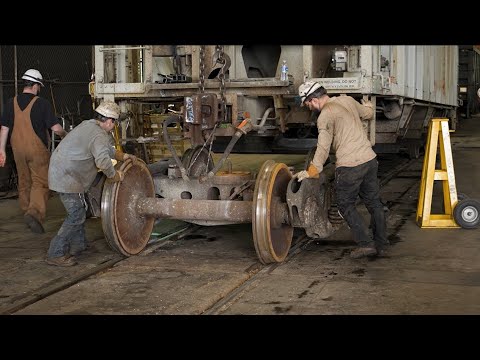
Photo: Wolfmann (CC BY-SA 4.0)
Job description
Repairers inspect components such as bearings, seals, gaskets, and coupler assemblies to figure out what's failing, then remove and replace the worn parts using pneumatic hoists, welding equipment, and hand tools. Every repair gets tested before a car goes back into service, since a missed defect could cause a failure out on the line. Much of the work happens in a rail yard or maintenance shop as part of a crew, often in noisy conditions with exposure to hazardous equipment, so protective gear is standard. Experienced repairers can move up into lead mechanic or maintenance supervisor roles overseeing a shop's repair operations.
Pros
- Pay can reach over $95k without requiring any postsecondary education
- Skilled trade work diagnosing and repairing complex mechanical systems on rolling stock
- Faster than average projected job growth (2.8%) over the next decade
Cons
- A relatively small number of positions nationwide (around 1,500) limits opportunities
- Physically demanding work using heavy tools like torque wrenches, hoists, and welding equipment
- Regular exposure to hazardous equipment, noise, and working at heights
A typical day
The shift starts in the repair shed with the bad-order list: a hopper car flagged for a worn wheel bearing gets jacked, and the morning goes to pulling the wheelset — heavy, precise work with overhead cranes and hydraulic jacks where procedure is what keeps hands attached. Mid-shift brings air-brake work on a boxcar: testing the system, replacing a leaking valve, and re-testing until the gauges hold spec, because a train's brakes are a chain of cars that all have to work. Inspections fill the gaps — couplers, draft gear, safety appliances — each documented against federal standards. The day ends releasing repaired cars back to service and tagging the ones that need parts.
Tasks at the job
- Repair or replace defective or worn parts such as bearings, pistons, and gears, using hand tools, torque wrenches, power tools, and welding equipment.
- Remove locomotives, car mechanical units, or other components, using pneumatic hoists and jacks, pinch bars, hand tools, and cutting torches.
- Test units for operability before and after repairs.
- Inspect components such as bearings, seals, gaskets, wheels, and coupler assemblies to determine if repairs are needed.
- Adjust repaired or replaced units as needed to ensure proper operation.
- Repair, fabricate, and install steel or wood fittings, using blueprints, shop sketches, and instruction manuals.
Workplace & working conditions
Work happens indoors, though not always in a climate-controlled space, and most of the day is spent on your feet. Noise levels can be distracting or uncomfortable. The role involves regular exposure to hazardous equipment or conditions and contaminants and working at heights, and specialized protective equipment is standard.
There's a regular, moderate amount of time pressure, and you're expected to exercise significant independent judgment day to day.
Education necessary or common
High school diploma; some on-the-job training or apprenticeship
Licenses & certifications
- Welding certifications (AWS)
- OSHA 10
- Railroad-specific qualifications (employer-provided)
Career path
Related fields
Courses to take
- Shop/Mechanical Technology — the trade's foundation
- Physics — air brakes, leverage, and load mechanics
- Algebra — measurements and tolerances
- Welding — a core repair skill in car shops
Clubs, activities & competitions
- SkillsUSA — welding and mechanical competitions
- Auto shop club
- Robotics team — mechanical troubleshooting
- Any hands-on repair hobby
First steps you can take now
- Take welding and shop classes now — railroads hire for mechanical aptitude
- Get OSHA 10 online
- Look up Class I railroad (BNSF, UP, CSX, NS) carman/mechanical hiring pages and requirements
- Watch videos on how railroad air brakes work — it's a genuinely clever system worth understanding