Photo: U.S. Government Accountability Office (Public domain)
Job description
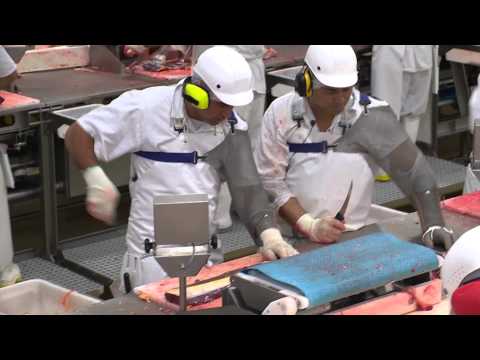
Depending on the station, the job might mean stunning and slaughtering animals under strict safety and sanitation rules, cutting and deboning carcasses into specified portions, or weighing, wrapping, and labeling finished products for shipment. Workers also inspect meat for quality or contamination issues and clean and sanitize equipment between shifts, all governed by strict USDA food-safety protocols. It's cold, physically demanding work on a fast-moving line, with real injury risk from sharp tools and machinery that makes following safety procedure non-negotiable.
Pros
- Entry only requires a high school diploma plus on-the-job training, no college needed
- Over 8,400 positions nationwide, offering steady, ongoing demand in food production
- Steady, non-shrinking demand, with modest projected growth (2.2%) rather than decline
Cons
- Physically demanding, repetitive work on a fast-moving line for a full standing shift
- Real injury risk from sharp tools, heavy machinery, and a cold, wet processing environment
- Pay tops out well below the median for full-time work, even with above-average hours
A typical day
The plant day starts with PPE — cut-resistant gloves, apron, and the knife kit that's the worker's personal responsibility to keep surgical-sharp, because a sharp knife is a safe knife. On the line, the work is specialized repetition: each station owns one cut, done thousands of times with a precision that protects both the product's value and the worker's hands. USDA inspectors walk the floor; sanitation and food-safety rules structure everything. The mid-shift rotation moves the worker to packing — vacuum sealing, boxing, and palletizing in the chilled rooms where everyone dresses for winter indoors. Knife skills climb a real wage ladder here: the skilled cuts pay meaningfully more, and the industry constantly promotes from the line. Honest, demanding, essential work.
Tasks at the job
- Stun, slaughter, or eviscerate animals following safety and sanitation procedures.
- Cut, trim, or debone carcasses into specified portions using knives or powered equipment.
- Weigh, wrap, label, or box meat products for shipment.
- Clean and sanitize equipment, tools, and work areas between shifts.
- Inspect meat for quality or contamination issues and remove substandard product.
- Follow strict USDA and food-safety protocols throughout each step of processing.
Workplace & working conditions
Work happens indoors in a cold, wet processing plant, standing for the full shift on a fast-moving production line. The environment involves blood, strong odors, sharp tools, and heavy machinery, and protective gear — cut-resistant gloves, aprons, boots — is required.
The line moves at a set, often fast pace that leaves little flexibility in timing, and the work is physically repetitive and demanding. Injury risk is real given the tools and machinery involved, so following safety procedure precisely matters.
Education necessary or common
High school diploma; some on-the-job training or apprenticeship
Licenses & certifications
- Food handler certification
- HACCP training (employer-provided)
- OSHA 10
Related fields
Courses to take
- Biology/Animal Science — anatomy knowledge is the trade's map
- Health — food safety fundamentals
- Physical Education — repetitive physical work rewards conditioning
- Consumer Math — yields and production counts
- FFA/Agriculture courses where offered
Clubs, activities & competitions
- FFA — meat judging and evaluation is a real competitive event
- 4-H livestock projects
- A kitchen or butcher-counter job — knife skills start anywhere
First steps you can take now
- Learn proper knife skills and sharpening in a kitchen setting
- Compete in FFA meat evaluation if your chapter offers it
- Get a food-handler card — cheap, fast, and relevant
- Look up meat processing employers' starting wages and advancement ladders in your region