Photo: Shixart1985 (CC BY 2.0)
Job description
A millwright typically starts from layout plans or blueprints, then uses hoists, jacks, lasers, and micrometers to align machinery down to exact tolerances, inserting shims and adjusting bolts until every clearance matches spec. Much of the job is done alongside crane operators and other trades, signaling lift positions and coordinating the placement of heavy equipment. Once a machine is installed, the same millwright often sticks around for its preventive maintenance and repairs, so the role blends one-time installation projects with the recurring upkeep of the same equipment over years.
Pros
- Pay ceiling near $94k achievable with just a high school diploma and apprenticeship
- Precision, hands-on mechanical work aligning and installing heavy machinery with specialized tools
- Team-based environment working alongside crane operators and other skilled trades
Cons
- Employment is flat, with essentially no projected growth over the next decade
- Above-average hours, often exceeding a standard 40-hour work week
- Fast-paced work where mistakes in alignment or clearance can have serious consequences
A typical day
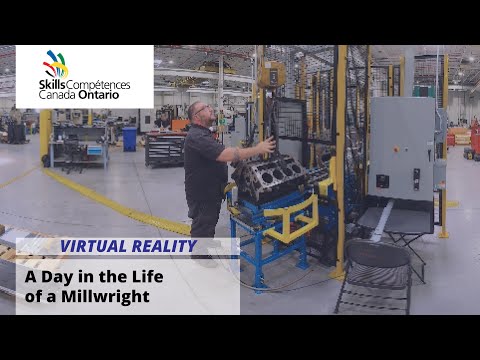
Today's job is setting a new gearbox in a paper mill, so the morning starts with rigging: calculating the lift, choosing slings, and walking the crane path before anything leaves the ground. By mid-morning the old unit is out and the new one hovers over its baseplate while the millwright works shims and a precision level to bring it flat within thousandths. The afternoon is coupling alignment with a laser rig — misalignment measured in hairs breaks machines in months. Between tasks there's a bearing replacement on a conveyor and a vibration reading that doesn't feel right. The tools go back in the box clean, because tomorrow is another machine.
Tasks at the job
- Replace defective parts of machine, or adjust clearances and alignment of moving parts.
- Align machines or equipment, using hoists, jacks, hand tools, squares, rules, micrometers, lasers, or plumb bobs.
- Insert shims, adjust tension on nuts and bolts, or position parts, using hand tools and measuring instruments, to set specified clearances between moving and stationary parts.
- Signal crane operator to lower basic assembly units to bedplate, and align unit to centerline.
- Conduct preventative maintenance and repair, and lubricate machines and equipment.
- Assemble and install equipment, using hand tools and power tools.
Workplace & working conditions
Work happens indoors, though not always in a climate-controlled space, and most of the day is spent on your feet, and you work in close physical proximity to coworkers or the public for much of the shift. Noise levels can be distracting or uncomfortable. The role involves regular exposure to hazardous equipment or conditions and contaminants and working at heights, and specialized protective equipment is standard.
The pace is often fast, with real time pressure to meet deadlines, and decisions come up constantly and often need to be made quickly. Mistakes can have serious consequences, so accuracy matters a lot. You'll regularly deal with frustrated or upset people as part of the job, and almost all of the work is done as part of a team.
Education necessary or common
High school diploma; some on-the-job training or apprenticeship
Licenses & certifications
- Registered apprenticeship completion (journeyman millwright)
- OSHA 10/30
- Rigging and signal person qualifications
- Forklift certification
Career path
Related fields
Courses to take
- Machine Shop, Welding, or Industrial Maintenance CTE courses — the trade's foundations
- Geometry and Trigonometry — rigging angles and alignment math are trig in work boots
- Physics — loads, leverage, and rotating equipment behavior
- Drafting or Blueprint Reading — installations start from drawings
- Algebra II — practical calculation fluency
Clubs, activities & competitions
- SkillsUSA — industrial maintenance and welding competitions
- FIRST Robotics — mechanical assembly and troubleshooting under deadline
- Home or farm mechanical projects — engines, equipment, anything with bearings
- Weightlifting or team sports — the job is genuinely physical
First steps you can take now
- Look up millwright apprenticeships through the UBC (union) and local contractors — earn while you learn, no degree needed
- Learn to read a machinist level and dial indicator from videos, then practice on anything flat
- Fix something mechanical this month and document the teardown
- Ask a plant maintenance manager what they look for in apprentice candidates