Photo: JeevaMuthuramalingam (CC BY-SA 4.0)
Job description
Beyond the core clinical testing, technologists take detailed medical histories, perform ocular measurements, and assist during minor surgeries using aseptic technique and instrument prep. They also supervise and instruct other ophthalmic support staff, extending their role beyond direct patient testing into training. The setting is precision-driven and team-oriented, with technologists regularly working face-to-face with patients under real time pressure.
Pros
- Faster than average projected growth (5.2%) with over 13,600 positions nationwide
- Broader scope than entry-level ophthalmic roles, including supervising other staff and assisting minor surgery
- Accessible without a four-year degree, vocational training or an associate's degree is enough
Cons
- Pay ceiling ($38k-$85k) is modest given the added supervisory and surgical-assist responsibilities
- Precision and accuracy are essential in taking measurements that guide diagnosis and treatment
- Regularly dealing with frustrated or anxious patients as part of the day-to-day role
A typical day
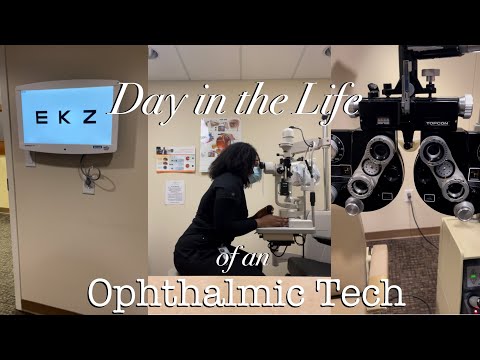
The day's schedule leans specialized: first up is an OCT scan session, capturing cross-sections of retinas in micrometer detail for the retina specialist's afternoon clinic, followed by fluorescein angiography — dye injected, timed photographs tracking blood flow through a diabetic patient's retina while the technologist watches for the rare adverse reaction. Late morning brings an A-scan biometry series, measuring eyes for cataract-surgery lens calculations where a bad measurement becomes a bad outcome. The afternoon includes advanced visual fields, an electroretinography setup few clinics can run, and assisting with minor procedures — instruments prepped, patient monitored, sterile field respected. The technologist also trains a new technician on the OCT, because at this level, teaching the team is part of the role. Every image made today becomes a decision tomorrow.
Tasks at the job
- Conduct tonometry or tonography tests to measure intraocular pressure.
- Take and document patients' medical histories.
- Take anatomical or functional ocular measurements, such as axial length measurements, of the eye or surrounding tissue.
- Measure visual acuity, including near, distance, pinhole, or dynamic visual acuity, using appropriate tests.
- Administer topical ophthalmic or oral medications.
- Measure and record lens power, using lensometers.
Workplace & working conditions
Work happens indoors in a climate-controlled setting, and you work in close physical proximity to coworkers or the public for much of the shift.
There's a regular, moderate amount of time pressure. Precision and accuracy are essential to the work. You'll regularly deal with frustrated or upset people as part of the job, and almost all of the work is done as part of a team.
Education necessary or common
Vocational training, apprenticeship, or associate's degree
Common college majors
Licenses & certifications
- Certified Ophthalmic Medical Technologist (COMT, JCAHPO)
- Certified Retinal Angiographer (CRA, specialization)
- CPR/BLS
Career path
Related fields
Courses to take
- Anatomy and Physiology — deep ocular anatomy is the profession's map
- Physics — advanced imaging lives on optics and signal principles
- AP Biology — retinal disease processes
- Photography — ophthalmic photography is a named part of the job
- Health Science CTE courses — clinical foundations
Clubs, activities & competitions
- HOSA-Future Health Professionals
- Photography club — imaging technique and composition discipline
- Volunteer at community vision screenings
- Science Olympiad — optics and anatomy events
First steps you can take now
- Learn what OCT imaging shows by exploring labeled scans free online — it's the field's signature instrument
- Ask a retina or ophthalmology practice to observe an imaging session
- Start the pathway: many technologists begin as on-the-job ophthalmic assistants and certify upward to COMT
- Practice careful photography — sharp focus and consistent technique translate directly