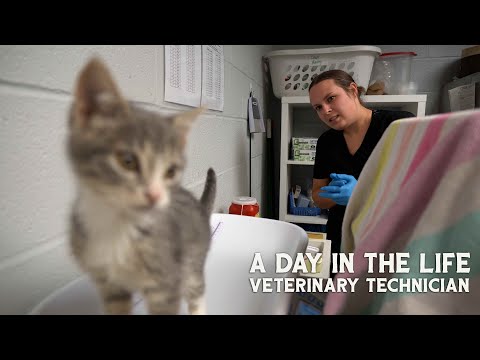
Photo: Maddelin Angebrand (Public domain)
Job description
Technicians administer anesthesia under a veterinarian's direction and closely monitor how an animal responds so dosages can be adjusted in real time, then help the animal recover afterward. Day to day work also includes preparing and administering prescribed medications and vaccines, restraining animals during exams, and maintaining the controlled drug inventory and its required log books. When something goes wrong quickly, technicians are trained to administer emergency first aid, including resuscitation. The work demands precision and composure under time pressure, since much of it happens in close physical contact with both animals and worried owners, as part of a broader clinical team.
Pros
- Much faster than average projected growth (9.1%) with broad demand across clinics and hospitals
- Low barrier to entry, an associate's degree or vocational training gets you working
- Hands-on animal care, from anesthesia to emergency first aid, for those who want direct impact
Cons
- Pay tops out modestly ($36k-$63k) despite the emotionally and physically demanding work
- Regular exposure to hazardous equipment, animal bites or scratches, and contaminants requiring PPE
- Restraining frightened or aggressive animals and comforting distressed owners is a routine part of the job
A typical day
The morning's surgery patients arrive by 7:30, and the tech runs their pre-op workups -- blood panels spun and read in-house, catheters placed, anesthesia machines checked. During surgery the tech is the anesthetist: monitoring depth, heart rate, and blood pressure while the veterinarian operates, adjusting in real time. The afternoon swings between radiographs on a limping shepherd, a dental cleaning done tooth by tooth, and client education about post-op care delivered with patience. The day ends with treatments for hospitalized patients and the charting that keeps overnight staff fully informed.
Tasks at the job
- Administer anesthesia to animals, under the direction of a veterinarian, and monitor animals' responses to anesthetics so that dosages can be adjusted.
- Care for and monitor the condition of animals recovering from surgery.
- Maintain controlled drug inventory and related log books.
- Prepare and administer medications, vaccines, serums, or treatments, as prescribed by veterinarians.
- Restrain animals during exams or procedures.
- Administer emergency first aid, such as performing emergency resuscitation or other life saving procedures.
Workplace & working conditions
Work happens indoors in a climate-controlled setting, and most of the day is spent on your feet, and you work in close physical proximity to coworkers or the public for much of the shift. Noise levels can be distracting or uncomfortable. The role involves regular exposure to hazardous equipment or conditions and contaminants, and specialized protective equipment is standard.
There's a regular, moderate amount of time pressure. Precision and accuracy are essential to the work. You'll regularly deal with frustrated or upset people as part of the job, and almost all of the work is done as part of a team.
Education necessary or common
Vocational training, apprenticeship, or associate's degree
Licenses & certifications
- CVT/LVT/RVT credential via the VTNE exam
- AVMA-accredited vet tech program (associate degree)
Career path
Related fields
Courses to take
- AP Biology -- physiology across species
- Chemistry -- pharmacology and lab work foundations
- Anatomy & Physiology -- the working map
- Algebra II -- drug-dose calculations are daily and safety-critical
- Animal science electives
Clubs, activities & competitions
- Veterinary clinic volunteering or kennel work
- Animal shelter service hours
- 4-H or FFA animal projects
- HOSA -- veterinary science competitive events exist
First steps you can take now
- Get a kennel assistant or clinic volunteer role now -- techs are promoted from proximity
- Practice dosage math -- mg per kg conversions cold
- Tour an AVMA-accredited vet tech program at a community college
- Shadow a credentialed vet tech for a surgery day