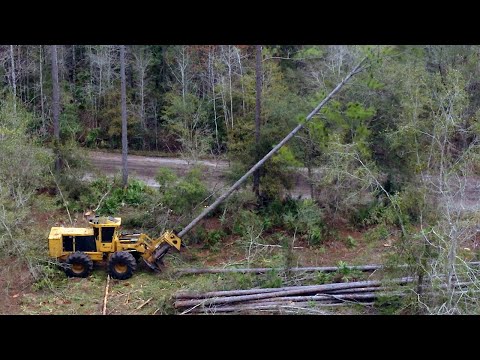
Photo: Heikki Valve (user 16valve) (CC BY-SA 3.0)
Job description
Depending on the equipment, operators might use a hydraulic tractor with tree clamps to lift and bunch sheared trees, or drive a tractor rigged with cable winches and a logging arch to skid, load, or stack logs and pull stumps. Machines also get used to build and repair the skid roads that logging operations depend on, and operators grade logs by knot size and straightness against industry standards as they work. Safety checks come before every shift, since mistakes with heavy equipment on uneven terrain can have serious consequences, and independent judgment is expected throughout the day.
Pros
- Pay can reach $74k at the top of the range with just a high school diploma and on-the-job training
- Work happens mostly seated inside heavy equipment, easier on the body than most logging roles
- High independent judgment operating specialized machinery like grapples and cable winches
Cons
- Above-average hours and employment projected to shrink slightly (-1.4%) over the next decade
- Mistakes carry serious consequences, so there is little margin for error
- Regular exposure to hazardous equipment, noise, and contaminants on the job site
A typical day
The crew truck reaches the landing at first light, and the operator climbs into a feller buncher worth more than a house — a machine that walks on tracks, grabs a standing tree, and lays it down in seconds. The morning's unit is a thinning job, and the skill is surgical: dropping selected trees without scarring the leave trees that constitute the forest's future. The cab is a cockpit of joysticks and screens, the operator's hands making a hundred decisions an hour while watching slope, wind, and the ground crew's positions religiously — separation distances are life-and-death rules in this trade. Midday brings a move to the skidder, dragging bunched logs to the landing where the loader sorts and stacks by grade. Equipment maintenance is the operator's religion: greasing, filter checks, a hydraulic line replaced at lunch. The unit's production tally ends the day — loads out, acres done — and the woods go quiet again by dark.
Tasks at the job
- Inspect equipment for safety prior to use, and perform necessary basic maintenance tasks.
- Control hydraulic tractors equipped with tree clamps and booms to lift, swing, and bunch sheared trees.
- Grade logs according to characteristics such as knot size and straightness, and according to established industry or company standards.
- Drive straight or articulated tractors equipped with accessories such as bulldozer blades, grapples, logging arches, cable winches, and crane booms to skid, load, unload, or stack logs, pull stumps, or clear brush.
- Drive crawler or wheeled tractors to drag or transport logs from felling sites to log landing areas for processing and loading.
- Drive tractors for building or repairing logging and skid roads.
Workplace & working conditions
Work happens mostly inside a vehicle or piece of equipment, and most of the day is spent sitting at a desk. Noise levels can be distracting or uncomfortable. The role involves regular exposure to hazardous equipment or conditions and contaminants, and standard protective equipment (gloves, safety glasses, and similar) is expected.
You're expected to exercise significant independent judgment day to day. Mistakes can have serious consequences, so accuracy matters a lot.
Education necessary or common
High school diploma; some on-the-job training or apprenticeship
Licenses & certifications
- Chainsaw safety certification (Game of Logging or state equivalent)
- First Aid/CPR — required on remote crews
- State logger safety training programs (many timber states mandate them)
- CDL — valuable for moving equipment
Career path
Related fields
Courses to take
- Shop/Diesel Mechanics — the machines demand mechanical fluency
- Physics — falling trees and loaded grapples are force problems
- Biology/Forestry electives — the resource being harvested
- Geometry — slopes, distances, and unit boundaries
- Business Math — production pay and equipment economics
Clubs, activities & competitions
- FFA — forestry events and equipment exposure
- SkillsUSA — diesel and heavy equipment
- Farm or ranch work — equipment seat time transfers
- 4-H forestry or engineering projects
First steps you can take now
- Get seat time on any equipment available to you — tractors, skid steers, excavator simulators
- Watch professional feller buncher and skidder operation videos to see the craft's ceiling
- Contact logging contractors in timber regions about ground crew jobs — operators are grown from ground workers
- Take a chainsaw safety course (Game of Logging or similar) — the foundational credential